
Share This Post
If you have dark skin and you have ever been told you are “not suitable” for laser hair removal, you were likely hearing an outdated shortcut, not a clinical truth. The reality is more precise: laser hair removal can be highly effective on deeper skin tones, but it is less forgiving of poor device choice, rushed settings, and weak aftercare. That is why the consultation matters as much as the laser.
In clinic, we treat skin as biology first and aesthetics second. For darker skin tones, that mindset is the difference between a smooth, predictable course and a frustrating cycle of missed patches, irritation, and pigment marks that were avoidable.
How laser hair removal works – and why melanin changes the rules
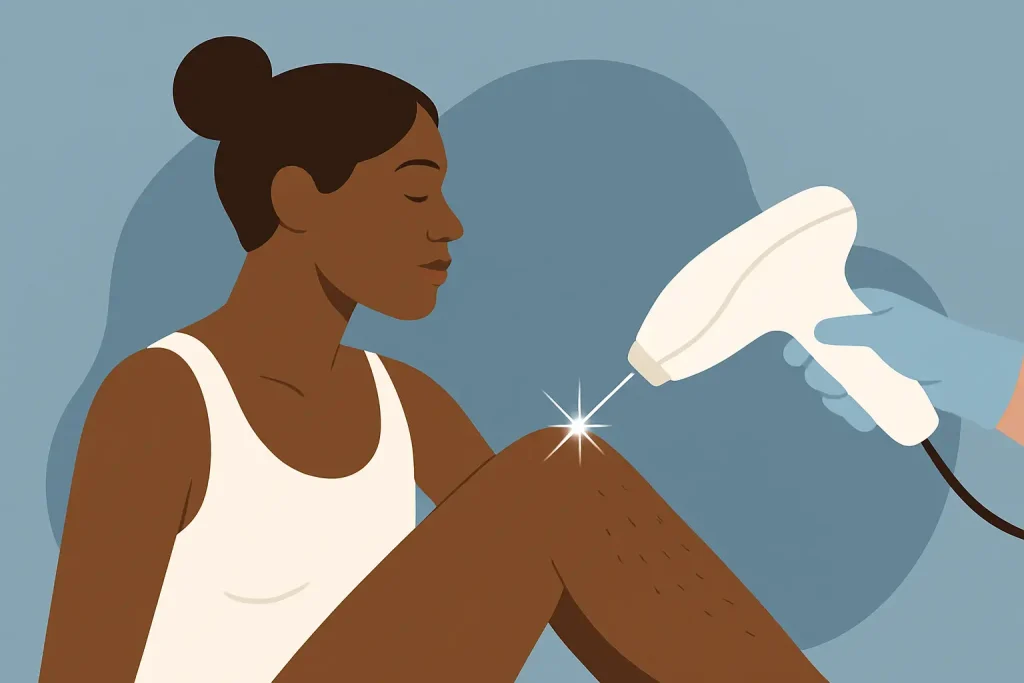
Laser hair removal targets pigment (melanin) inside the hair shaft and follicle. The light converts to heat, and that heat damages the follicle’s ability to regrow strong hair. This is also why you need multiple sessions: only hairs in the right growth phase (anagen) respond fully at the time of treatment.
Here is the key point for laser hair removal for dark skin: melanin is not only in the hair. It is also in the epidermis, and the darker the skin, the more epidermal melanin is present. If a laser “sees” too much melanin at the skin surface, it can deliver heat where you do not want it, which increases the risk of burns, blistering, and post-inflammatory hyperpigmentation (PIH).
So the question is not “Can it be done?” The question is “Can it be done with the correct wavelength, pulse duration, cooling, and a therapist who understands how your skin behaves?”
The safest laser types for darker skin tones
Not all lasers are built for melanin-rich skin. The right choice is the one that preferentially heats the follicle while minimising epidermal absorption.
Why Nd:YAG is often the gold standard
A 1064 nm Nd:YAG laser is widely used for darker skin because its wavelength penetrates more deeply and is less absorbed by epidermal melanin than shorter wavelengths. That means the energy can be directed to the follicle with a wider safety margin.
It is not “painless” and it is not a quick fix, but it is a clinically sensible option for many Fitzpatrick IV to VI skin types, particularly on coarse hair areas like underarms, bikini, legs, and beard-line shaping.
Where diode can fit – with the right approach
Diode lasers (commonly around 810 nm) can be effective, and some platforms are designed with darker skin in mind. The important caveat is that diode devices demand excellent technique and conservative parameter selection on deeper skin tones. When clinics chase speed or intensity, the risk profile changes.
Why IPL is usually a no for dark skin
IPL is not a laser. It is broad-spectrum light, and it can be unpredictable on darker skin because it disperses energy across multiple wavelengths that interact with melanin. For some deeper skin tones, IPL increases the risk of PIH without offering the controlled targeting you want.
If you are choosing between “a cheap IPL deal” and “a properly planned course with the right laser”, treat it like you would any clinical decision. Your skin remembers shortcuts.
What a proper consultation should include
If a clinic is serious about outcomes, the first appointment is not a sales pitch. It is assessment, education, and planning.
Your therapist should ask about your tanning habits, recent sun exposure, hormonal history, and any tendency to pigment after spots, insect bites, or previous treatments. They should also discuss medications and topicals that may increase sensitivity.
Patch testing is not optional for many darker skin clients. A patch test allows your therapist to confirm skin response before committing to full areas. With melanin-rich skin, we are looking for controlled follicular response without excessive heat reaction at the surface.
A consultation should also include expectation setting about hair type. Laser responds best to dark, coarse hair on lighter-to-medium skin, but that does not mean deeper skin cannot get excellent results. It means the therapist must be honest about the variables that influence speed and completeness.
Settings matter more than promises
You can have the “right laser” and still get a poor result if settings are wrong. This is where clinical experience shows.
On darker skin, a safe and effective plan often uses longer pulse durations, appropriate spot size, thoughtful fluence selection, and strong epidermal cooling. Good practice does not mean under-treating. It means treating progressively.
If you are offered a one-size-fits-all setting, or the clinic cannot explain how they tailor parameters for your skin, treat that as a red flag. With deeper skin tones, precision is the safety feature.
What results look like – realistic timelines for dark skin
Most clients notice reduced hair density and slower regrowth after a few sessions, but the exact pace depends on area, hair thickness, hormones, and how consistent you are with scheduling.
Typically, you are looking at a course of sessions spaced to match growth cycles. Underarms and bikini often move faster than legs. Facial areas can be more hormone-driven and may need more maintenance, especially for clients managing PCOS or perimenopausal changes.
A clinically honest promise is this: you can expect significant long-term reduction and easier maintenance, not necessarily “permanent removal” of every single hair forever. Hair biology can change over time, but a well-run course gives you control and predictability.
The pigmentation question: PIH, burns, and how to prevent them
The biggest fear for dark skin clients is not the discomfort – it is pigment change. That fear is valid, and it is also manageable with the right protocol.
Post-inflammatory hyperpigmentation happens when the skin experiences irritation or injury and responds by producing more melanin. On deeper skin tones, even minor inflammation can leave a mark.
Prevention is a process. It starts with device choice and settings, continues with strict sun avoidance around treatment, and is reinforced by barrier-supportive skincare. If you are actively tanning, using sunbeds, or you cannot realistically protect the area from UV, it may be wiser to delay treatment than to gamble with pigment.
If you are prone to pigmentation, ask your therapist how they manage it in their treatment planning. The answer should include aftercare guidance and what they will do if your skin shows early signs of overstimulation.
Preparing your skin for treatment (and why it affects outcome)
Good prep reduces irritation and improves consistency of results.
Arrive with clean skin, no deodorant, no heavy body oils, and the area shaved as advised. Waxing, threading, and plucking remove the target (the hair root), so they must be paused before a laser course. Shaving is different: it leaves the follicle intact but removes surface hair, reducing surface heat.
If you use active skincare on the face or neck (retinoids, exfoliating acids, brighteners), disclose it. Your therapist may advise pausing certain products around treatment to reduce sensitivity.
Aftercare that protects dark skin
The first 48 hours are about calm, cool, and protected skin. Heat, friction, and aggressive products can all tip skin into inflammation.
Expect mild perifollicular redness or a “goosebump” look after treatment. That can be a normal sign of follicular response. What is not normal is blistering, grey/white patches, or intense swelling.
For body areas, keep showers lukewarm, skip saunas and high-intensity exercise for a short period, and avoid fragranced products if you are reactive. For exposed areas, daily high-protection SPF is not negotiable if you want to minimise PIH risk.
If you are also managing pigmentation or acne, talk to your therapist about integrating brightening and barrier-supportive products in a way that complements the laser course rather than competing with it.
When laser is not the right choice (and what to do instead)
A specialist clinic should be willing to say “not yet” or “not for this area” when it is clinically sensible.
Laser is less effective on very light, grey, or red hair because there is not enough melanin in the hair to absorb the energy. It can also be tricky on fine vellus hair, especially on the face, where stimulating thicker regrowth is a concern for some clients.
If your hair growth is strongly hormone-driven, laser can still help, but you may need a longer plan and maintenance sessions. In some cases, combining medical management (through your GP or specialist) with laser gives better long-term stability.
Choosing a clinic: the questions that protect your skin
With darker skin, you are not being “difficult” by asking detailed questions. You are being sensible.
Ask what laser platform is used and why it is appropriate for your skin type. Ask whether they patch test, how they adjust settings across sessions, and what their protocol is if you pigment easily. Ask about therapist training and whether your treatments are therapist-led throughout the course.
If you want a consultation-first, skin-health-led approach in Greater Manchester, you can book a structured laser consultation with GRB Skin Clinic and have your plan built around your skin behaviour, your hair type, and your long-term outcome rather than a generic package.
A helpful closing thought: the goal is not to “handle” dark skin with extra caution – it is to treat it with extra competence. When the process is precise, progressive, and personalised, your skin can stay calm while your results build session by session.