
Share This Post
You finally get your skin to settle, the inflammation eases, breakouts reduce, and then a few weeks or months later the spots come back. If you have ever asked why acne returns after treatment, the answer is usually not that your skin has “failed” or that nothing works. In most cases, acne has not been managed for long enough, deeply enough, or specifically enough for your skin’s underlying triggers.
This is where many people lose confidence. They have tried products, facials, prescriptions, or a course of treatment and expected the acne to be over. But acne is rarely a one-step correction. It is a chronic inflammatory skin condition with multiple drivers, and if those drivers are still active beneath the surface, the breakouts can return even after a period of improvement.
Why acne returns after treatment in the first place
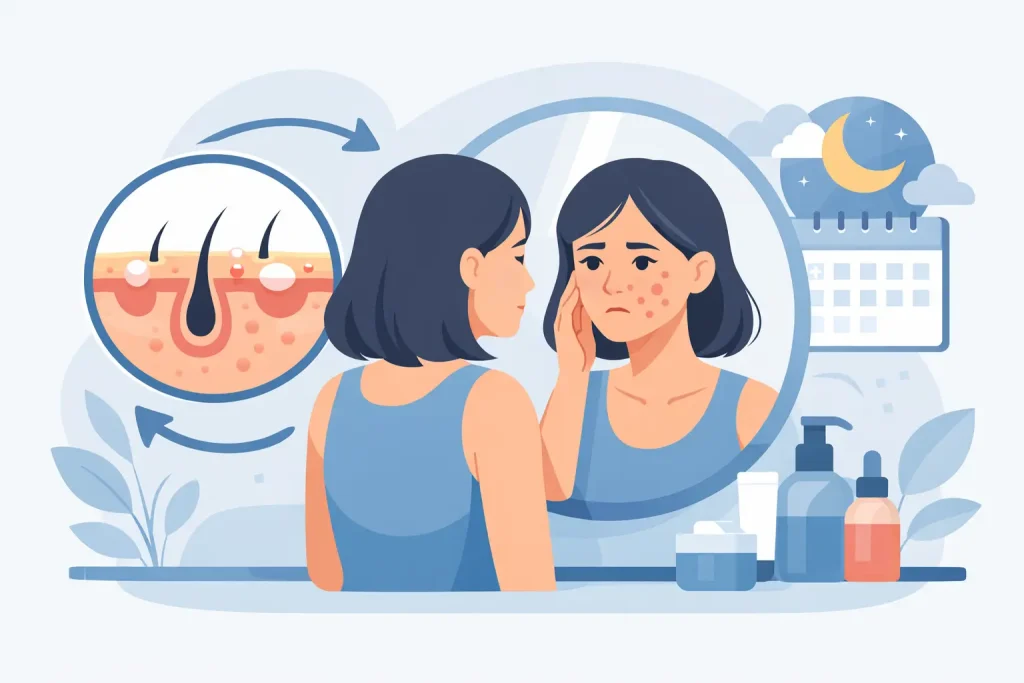
Acne does not begin only on the surface. It develops through a combination of excess oil production, sticky dead skin cells, blocked follicles, bacterial overgrowth, inflammation, and often hormonal influence. Treatment may calm one part of that cycle very effectively, but if the rest of the cycle remains active, relapse is possible.
For example, you might use a product that dries active spots well, but if your pores are still congesting faster than your skin can shed naturally, new blemishes will keep forming. Equally, if inflammation reduces after a treatment course but your hormones continue to stimulate oil production, acne may reappear once treatment is stopped.
This is why short-term improvement is not always the same as long-term control. Skin can look clearer before it is truly stable.
The most common reasons acne comes back
Treatment stopped too early
One of the biggest reasons acne returns is simply timing. Many people stop treatment as soon as the skin looks better. Clinically, that is often too soon.
Acne lesions begin forming weeks before they appear visibly. So when the skin surface looks clearer, there may still be microcomedones developing underneath. If active treatment is withdrawn too quickly, those hidden blockages continue their progression and the acne returns.
This is particularly common after antibiotics, peels, or a prescribed routine that was followed only until the skin improved. Improvement is the start of maintenance, not the end of treatment.
The wrong trigger was treated
Not all acne behaves the same way. Congestion across the forehead and cheeks, inflamed jawline acne, adult hormonal breakouts, and acne linked to barrier damage do not always respond to the same plan.
A person may treat oil when the real issue is inflammation. Another may focus on exfoliation when their acne is being aggravated by hormonal fluctuation or occlusive products. If the root cause has not been identified properly, treatment may give temporary relief without delivering lasting change.
This is why a structured consultation matters. Good skin treatment is not guesswork. It should begin with skin analysis, product review, lifestyle discussion, and a realistic plan for what needs to be corrected first.
Your skin barrier has been compromised
Over-treating acne is extremely common. Many people use too many acids, too much benzoyl peroxide, harsh scrubs, alcohol-heavy cleansers, or a rotating mix of trending products. The result is often irritated, dehydrated skin that becomes more reactive and inflamed.
When the barrier is impaired, skin can become tight, shiny, flaky, sore, and paradoxically more breakout-prone. This is because inflammation rises, healing slows, and the skin becomes less able to regulate itself properly.
In this situation, acne may seem as though it is resistant, when in fact the skin is struggling to tolerate what is being used on it. Sometimes the next step is not stronger treatment, but smarter treatment.
Hormones are still driving the condition
Hormonal acne is one of the clearest examples of why acne can recur. If breakouts cluster around the chin, jawline, lower cheeks, or worsen around your cycle, there may be an endocrine component involved.
Topical products can help control the visible symptoms, but they may not fully switch off the hormonal trigger. Stress, perimenopause, polycystic ovary syndrome, coming off contraception, poor sleep, and insulin fluctuations can all influence breakouts.
This does not mean treatment cannot work. It means treatment often needs to be ongoing, adjusted over time, and supported with the right homecare rather than approached as a quick fix.
Why acne returns after treatment even when products seemed to work
Sometimes the products did work. They reduced bacteria, softened congestion, improved cell turnover, or calmed inflammation. The problem is that acne-prone skin usually needs a maintenance strategy after the correction phase.
Think of acne management in two stages. First, you bring the condition under control. Then you keep the skin stable while reducing the chance of future flare-ups. If the second stage is missing, old patterns often return.
Maintenance does not need to mean an aggressive routine forever. In fact, it usually means the opposite – a balanced programme that keeps pores clear, supports barrier function, manages inflammation, and suits your skin’s tolerance. This may include professional treatments at planned intervals and a home routine that is specific, not excessive.
Inconsistent homecare
Clinical treatments can create excellent momentum, but what happens between appointments matters just as much. If homecare is inconsistent, products are changed frequently, or active ingredients are used incorrectly, progress can stall.
This is where many people unintentionally undo good work. They start skipping steps when the skin improves, borrow products from friends, mix prescription products with strong over-the-counter actives, or follow advice online that does not match their skin condition.
Long-term acne improvement depends on consistency more than intensity. The skin responds best to a routine it can tolerate and repeat.
Products or habits are still clogging the skin
Another reason acne returns after treatment is continued exposure to triggers that keep congestion forming. This may include comedogenic make-up, heavy hair products around the hairline, occlusive SPF textures that do not suit acne-prone skin, frequent touching, or poor cleansing after exercise.
Even helpful products can become unhelpful if they are wrong for your skin type. A rich balm that comforts dry skin may overwhelm someone prone to blocked pores. Likewise, over-cleansing can trigger compensatory oiliness and irritation.
There is rarely one universal “acne-safe” product category. Suitability depends on the individual, the skin barrier, the environment, and the rest of the routine.
What actually reduces the risk of recurrence
Long-term improvement comes from building a treatment plan around the biology of your skin, not just the appearance of today’s spots. That means looking at oil flow, inflammation, barrier health, sensitivity, pigmentation risk, scarring tendency, hormones, and lifestyle factors together.
A strong acne plan usually includes progressive treatment rather than one dramatic intervention. You may need a period of skin preparation before using stronger actives. You may need LED light therapy to calm inflammation alongside topical correction. You may need product prescription that changes as your skin becomes healthier. And you may need maintenance after the acne settles, because clear skin still needs support.
This is the approach we take at GRB Skin Clinic. Results are far more reliable when treatment is therapist-led, personalised, and adjusted as the skin changes, rather than based on a generic acne routine copied from elsewhere.
Expectation-setting matters
One of the most helpful shifts for acne sufferers is understanding that relapse does not always mean treatment failed. It may mean the skin needs a different level of support, a longer timeline, or a better-matched maintenance plan.
That is especially true if you have adult acne, recurrent congestion, post-inflammatory pigmentation, or a long history of using strong products without proper guidance. In these cases, skin often needs rehabilitation as much as correction.
The goal is not to chase every breakout with something harsher. The goal is to create conditions where the skin functions better over time.
When to reassess your treatment plan
If your acne keeps returning, reassessment is sensible when you notice a repeating cycle of temporary improvement followed by relapse, increased irritation, breakouts changing location or severity, or ongoing marks and scarring despite using treatment. These are signs that the current plan may be incomplete.
A proper review should look at what you are using, how often you are using it, what your skin is tolerating, and whether your treatment is targeting the true driver of the acne. It should also consider whether your skin now needs maintenance, barrier repair, hormonal support through medical referral, or more advanced in-clinic intervention.
Clearer skin is rarely about doing more. It is about doing what is correct, in the right order, for long enough.
If your acne has returned after treatment, do not assume you are back at the beginning. Often, the skin is giving you useful information. With the right analysis and a biologically intelligent plan, recurrent acne can be managed far more effectively – and with much less frustration.