
Share This Post
Congested skin rarely starts as a surface problem. What you see as blocked pores, persistent bumps and dullness is usually the end result of slower cell turnover, excess oil, inflammation and product choices that are not matched to your skin’s actual condition. That is exactly how active facials target congestion – not by scrubbing the skin into submission, but by correcting the processes that allow blockage to build in the first place.
What congestion actually means in clinical skin terms
Congestion is often used as a catch-all term, but in practice it can describe several different things. You may be dealing with compacted dead skin cells around the pore opening, retained sebum, microcomedones forming under the surface, or inflammatory lesions developing from long-standing blockage. Some clients also describe rough texture and under-skin bumps as congestion when the main issue is impaired barrier function and sluggish exfoliation.
This matters because treatment has to match the cause. If your skin is producing excess oil because it is inflamed, aggressive degreasing can make things worse. If you have closed comedones linked to poor desquamation, a generic facial may leave the skin looking brighter for a day without shifting the underlying pattern. Results come from precision, not from doing more.
How active facials target congestion at source
An active facial uses professional-grade ingredients and treatment steps chosen to influence skin function, rather than simply offering a relaxing cleanse and massage. The goal is to decongest while keeping the skin strong enough to recover well between appointments.
That usually begins with a thorough skin analysis. We look at where the congestion sits, whether it is mostly blackheads, closed comedones or inflamed breakouts, and whether there are signs of sensitivity, dehydration, post-inflammatory pigmentation or barrier disruption alongside it. Congestion is rarely a single-issue concern.
Once that picture is clear, the treatment can target the mechanisms driving the blockage. Active ingredients help loosen the build-up inside pores, accelerate cell turnover, reduce bacterial pressure, calm inflammation and support healthier oil flow. In a therapist-led setting, these steps are controlled carefully. That means stronger, more effective intervention than a standard maintenance facial, with better judgement around what your skin can tolerate.
Professional exfoliation without unnecessary trauma
One of the main reasons congestion lingers is that dead skin cells are not shedding cleanly. They mix with sebum and create the ideal environment for blockage. Active facials often use exfoliating acids or enzyme-based steps to soften and lift this material in a controlled way.
The key point is control. Over-exfoliation can leave the skin irritated, shiny and reactive, while still congested underneath. A well-designed active facial works with the skin’s biology. It encourages turnover so the pore can function more normally, but it does not strip the barrier for the sake of a dramatic after-feel.
Softening hardened impactions before extractions
Extractions can be useful when they are done properly and for the right lesions. They are far less helpful when the skin has not been prepared. Active facials often include treatment phases that soften hardened sebum and compacted debris first, making extractions cleaner and less traumatic.
That difference matters if you are prone to redness, pigmentation or post-breakout marks. For some clients, extensive extraction work is appropriate. For others, especially where inflammation is active, it is better to reduce the congestion progressively over a course of treatments rather than forcing everything out in one session.
Active ingredients that regulate, not just remove
A superficial clean-up can make skin feel smoother for a few days. A clinical facial should do more than that. Ingredients used within active facials are selected to influence the environment that produced the congestion in the first place.
Depending on the skin, this may include ingredients that help reduce excess oil, normalise keratinisation, support cell renewal or calm inflammatory activity. If acne is part of the picture, the treatment plan may also aim to reduce the frequency of future breakouts, not only improve what is visible that week. This is why product prescription between appointments is often the difference between a short-term result and meaningful change.
Why congestion often needs more than one facial
Clients sometimes expect congestion to clear fully after a single treatment. Occasionally there is a dramatic improvement, particularly if the build-up is mostly superficial. More often, there is a process.
Pores do not become blocked overnight, and the skin does not reset overnight either. If congestion is linked to recurring acne, hormonal fluctuations, unsuitable products, inconsistent homecare or chronic inflammation, one facial can start the correction but not complete it. A structured programme allows the skin to be treated in stages – decongesting, calming, rebuilding barrier health and then maintaining results.
This is where clinical guidance matters. It is not enough to perform a treatment and hope the skin behaves differently afterwards. You need to know why the congestion developed, what will keep feeding it, and how to reduce that cycle safely.
The balance between active treatment and skin tolerance
Stronger is not always better. One of the biggest mistakes with congested skin is treating it as though it needs to be dried out, scrubbed away or pushed harder at every appointment. That approach can create heat, irritation and rebound oiliness, especially in adult skin.
Many congested clients are also dehydrated. Some have a compromised barrier from previous overuse of acids or harsh anti-blemish products. Others are managing pigmentation left behind by old breakouts. In these cases, the most effective active facial is often one that combines decongesting steps with barrier-supportive ingredients and anti-inflammatory support.
This is why bespoke treatment planning matters. Two people can both present with blocked pores across the cheeks and jawline, yet one may need more corrective exfoliation while the other needs inflammation control and a gentler progression. Good skin therapy is responsive, not formulaic.
Where LED and supportive therapies fit in
In a progressive clinic setting, active facials do not have to work alone. Device-led support can improve outcomes, particularly when congestion is accompanied by active acne, slower healing or redness.
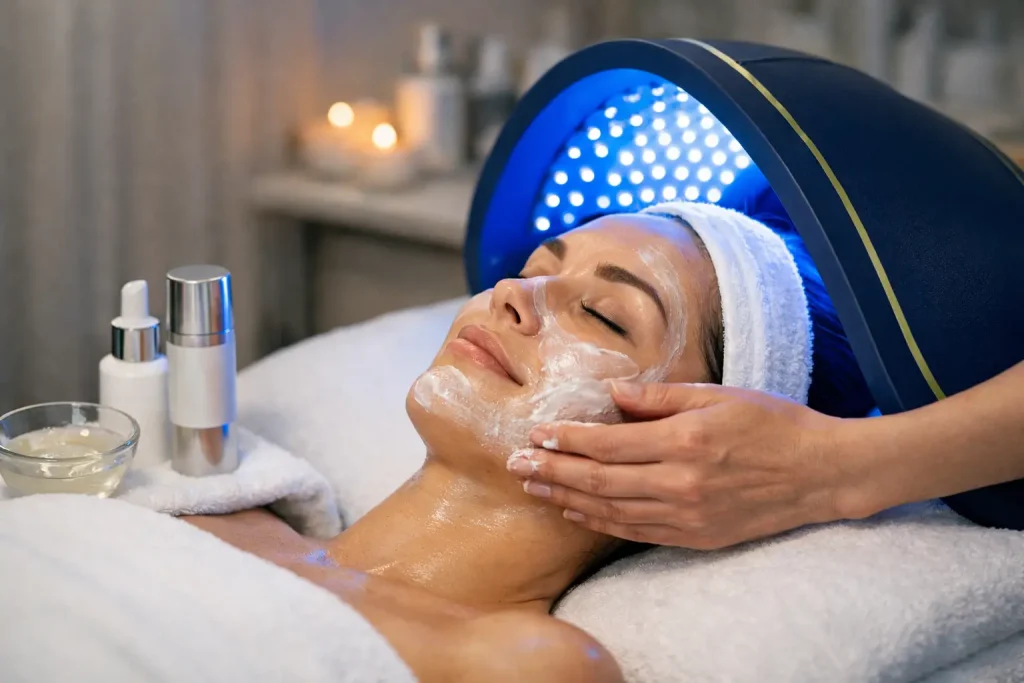
LED light therapy is a good example. It can be used to support the skin after decongesting treatment, helping to calm inflammation and assist recovery. For clients whose breakouts are not just clogged but angry and persistent, this can be an important part of the plan. The point is not to throw multiple treatments at the skin, but to combine therapies with a clear purpose.
Homecare is not optional if you want congestion to stay down
A facial can create momentum, but your daily routine determines whether congestion rebuilds. If homecare is too rich, too abrasive or simply not suitable for your skin condition, blocked pores return quickly. If it is well prescribed, it extends the effect of each treatment and helps the skin function better between visits.
That usually means using products that support controlled exfoliation, healthy vitamin activity and barrier balance without overwhelming the skin. It may also mean stopping products that feel active but are quietly keeping the skin irritated. This is one reason a consultation-first approach is so valuable. You are not left guessing which step is helping and which is setting you back.
At GRB Skin Clinic, this joined-up approach is central to results. Treatment in clinic and product prescription at home should support the same goal, so progress is measurable rather than random.
Who benefits most from active facials for congestion
Active facials are particularly useful for clients with recurring blackheads, under-skin bumps, acne-prone texture and skin that always looks dull no matter how much they cleanse. They can also be valuable for adults who thought they had “grown out” of breakouts but continue to struggle with congested jawlines, enlarged pores and uneven skin behaviour.
They are not a one-size-fits-all answer for every skin concern. If the skin is extremely inflamed, highly sensitised or compromised, treatment may need to begin with stabilising the barrier before stronger decongesting work is introduced. That is not a delay in results. It is often what makes long-term improvement possible.
What to expect after treatment
After an active facial, skin often feels cleaner, smoother and less heavy, but the exact response depends on what was treated. If congestion has been deeply addressed, you may notice some temporary sensitivity or mild purging in areas where blockages were forming under the surface. That is different from a treatment causing harm, but it should still be monitored properly.
Expect improvement in stages. Texture usually changes first. Then the frequency of congestion begins to reduce. Over time, with the right treatment intervals and homecare, the skin tends to look calmer, clearer and more refined overall. That is the real value of clinical active facials – not a quick cosmetic effect, but movement towards skin that behaves in a healthier, more predictable way.
If your skin keeps cycling through blocked pores, breakouts and roughness, the next step is not another random facial. It is a proper assessment, a structured plan and treatment that respects skin biology while asking more of it.