
Share This Post
A few unwanted hairs on the chin can feel far more persistent than a full lower-leg routine. That is why laser versus electrolysis is not simply a question of which treatment is better. It is a decision about your hair colour, skin tone, treatment area, hormonal picture, timescale and the result you genuinely want to maintain.
Both treatments can be highly effective when selected and performed correctly. They work in entirely different ways, however, and they suit different patterns of hair growth. A proper consultation should establish the safest, most efficient route rather than placing every client on the same course.
Laser versus electrolysis: the fundamental difference
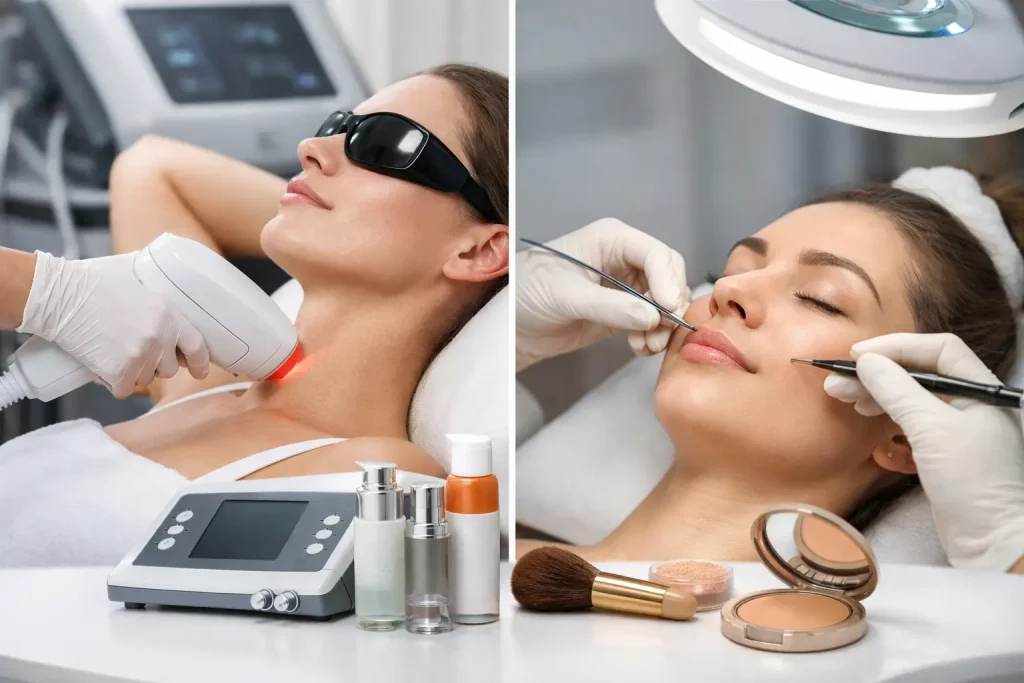
Laser hair removal uses carefully controlled light energy to target melanin, the pigment within the hair. The energy travels down the hair shaft and heats the follicle, disrupting its ability to produce new hair. Because a laser can treat many follicles within one pulse, it is particularly useful for larger areas such as the legs, underarms, bikini line, back and chest.
Electrolysis treats one follicle at a time. A very fine sterile probe is placed into the natural opening of the follicle, then a small electrical current is used to disable the hair-growth cells. The treated hair is removed with tweezers. It is meticulous work, which is why practitioner skill, hygiene and consistency matter so much.
The practical distinction is clear: laser is designed for efficient, long-term hair reduction across areas with suitable hair and skin characteristics. Electrolysis is recognised as a permanent hair removal method because each follicle is treated individually. It can also treat hairs that laser cannot reliably target.
When laser hair removal is the stronger choice
Laser tends to be the most time-efficient starting point when there is a substantial amount of dark, coarse hair. It is commonly selected for underarms, lower legs, Hollywood or Brazilian areas, and larger body zones where treating every follicle individually would take considerable time.
The best laser response usually comes from hair with enough pigment for the device to identify. Dark hair against lighter skin has traditionally offered the clearest contrast, but modern professional systems and carefully adjusted settings can broaden suitability. This does not mean every skin tone, hair colour or medical history should be treated in the same way. Skin assessment and patch testing are essential before a course begins.
Hair grows in cycles. Laser has its greatest effect when a hair is in an active growth phase, so appointments must be spaced to meet the cycle of the area being treated. A course often involves several sessions, followed by review appointments or occasional maintenance. The number required varies with the body area, hair density, previous hair-removal methods and hormonal influences.
A common expectation to reset is this: laser does not promise that every treated follicle will never produce another hair. It is a progressive reduction treatment. Many clients achieve a dramatic and worthwhile reduction in density, thickness and shaving frequency, but ongoing hormonal changes can encourage dormant follicles to become active later.
Laser can be especially useful for larger areas
A lower-leg session can be completed far more quickly with laser than electrolysis. For clients balancing work, family and regular appointments, that efficiency is often decisive. The treatment sensation is commonly described as a quick warm flick or elastic-band snap, and cooling measures can improve comfort.
Preparation affects safety and results. The area is usually shaved before treatment so energy can focus below the skin surface rather than singeing visible hair. Waxing, plucking and threading remove the hair root and can interrupt the treatment plan, so your therapist will advise on the right preparation between sessions.
When electrolysis is worth the time
Electrolysis is often the right answer for white, grey, blonde, red or very fine hairs. These hairs contain little or no pigment for a laser to target consistently, yet they can still be treated follicle by follicle with electrolysis.
It is also exceptionally valuable for small, detailed areas. A few hairs around the upper lip, chin, jawline, nipples, fingers or brows may not justify a laser course, particularly when the hair is sparse. Electrolysis gives the practitioner precision: each individual hair can be assessed and treated without relying on colour contrast.
For clients seeking a permanent outcome on a limited number of hairs, electrolysis may be the more direct route. The commitment is time. Every follicle requires its own treatment, and hairs are only visible at certain points in their growth cycle. Clearing an area once does not mean all follicles in that area have been treated. Repeated appointments are needed to catch new growth as it emerges.
Electrolysis and hormonal hair growth
Facial hair linked to hormonal change requires sensitive expectation-setting. Conditions such as polycystic ovary syndrome, perimenopause and some medications can stimulate new follicles over time. Electrolysis can permanently treat the follicles that are treated, but it cannot prevent the body from activating new ones.
That does not make treatment ineffective. It means the plan must be realistic. Many clients use laser to reduce dense dark growth first, then choose electrolysis to clear the lighter, finer or more isolated hairs that remain. This combined approach can be an intelligent use of both technologies, rather than a compromise.
Comparing time, comfort and cost
Cost should be assessed over the whole treatment journey, not only by the price of a single appointment. Laser sessions can cost more per visit but cover large areas quickly. Electrolysis appointments may begin at a lower price point, but a large area can require many hours of detailed work.
Comfort is personal. Laser delivers rapid pulses and can feel intense in sensitive areas, although the sensation passes quickly. Electrolysis creates a brief heat or sting sensation in each follicle. For a small area, this may feel very manageable. For dense facial growth or a broad body area, it can become more demanding simply because treatment takes longer.
Recovery is also different from person to person. Temporary redness, warmth and slight swelling around follicles can occur after either treatment. With electrolysis, tiny scabs may develop and should be allowed to heal naturally. With laser, skin can look and feel warm for a short period. Your therapist should provide clear aftercare based on your skin and the area treated, including guidance on heat, exercise, sun exposure and active skincare products.
Safety starts with a consultation, not a machine
Neither laser nor electrolysis should be treated as a casual beauty appointment. A thorough consultation checks your skin type, hair characteristics, medical history, medication, recent sun exposure, tendency to pigmentation changes and any history of poor healing. It also creates space to discuss what has changed in your hair growth and what outcome would make a real difference to your confidence.
For laser, patch testing helps establish an appropriate setting and confirms how your skin responds. For electrolysis, sterile single-use probes and careful technique are non-negotiable. In either treatment, the goal is controlled, progressive work that respects skin health.
Be cautious of promises that suggest one session can solve a long-standing hair concern. A trustworthy plan explains the likely number and spacing of sessions, the factors that may alter progress, and when a different treatment route would be more suitable. If a hair is too pale for laser, forcing repeated laser sessions is not an efficient answer. If an area is large and densely covered with dark hair, electrolysis alone may be unnecessarily slow.
How to choose between laser and electrolysis
Choose laser when your priority is reducing dark, coarse hair over a larger area with an efficient course of treatment. Choose electrolysis when the hairs are light, grey, red, fine or isolated, or when your goal is permanent removal of individual follicles. Choose a combination when laser can reduce the bulk and electrolysis can refine what remains.
At GRB Skin Clinic, treatment planning begins with the person in front of us, not a pre-set package. Your hair pattern, skin health and long-term goal deserve a considered recommendation and a clear plan for the months ahead.
The best next step is not to guess which method you ought to have. Book a consultation, bring your questions, and let a trained therapist assess the hair you want to treat. A well-chosen course can turn a frustrating routine into steady, visible progress.