
Share This Post
You can do the most advanced LED course, invest in professional vitamin A, and commit to consistent pigmentation management – then quietly undo a chunk of it with one habit: inconsistent sunscreen.
Photoaging is not “just getting older”. It is ageing that is accelerated by ultraviolet exposure, and it shows up exactly where most clients care most: fine lines around the eyes, leathery texture, enlarged pores, uneven tone, stubborn pigmentation, and that dullness that makes skin look tired even when you feel well.
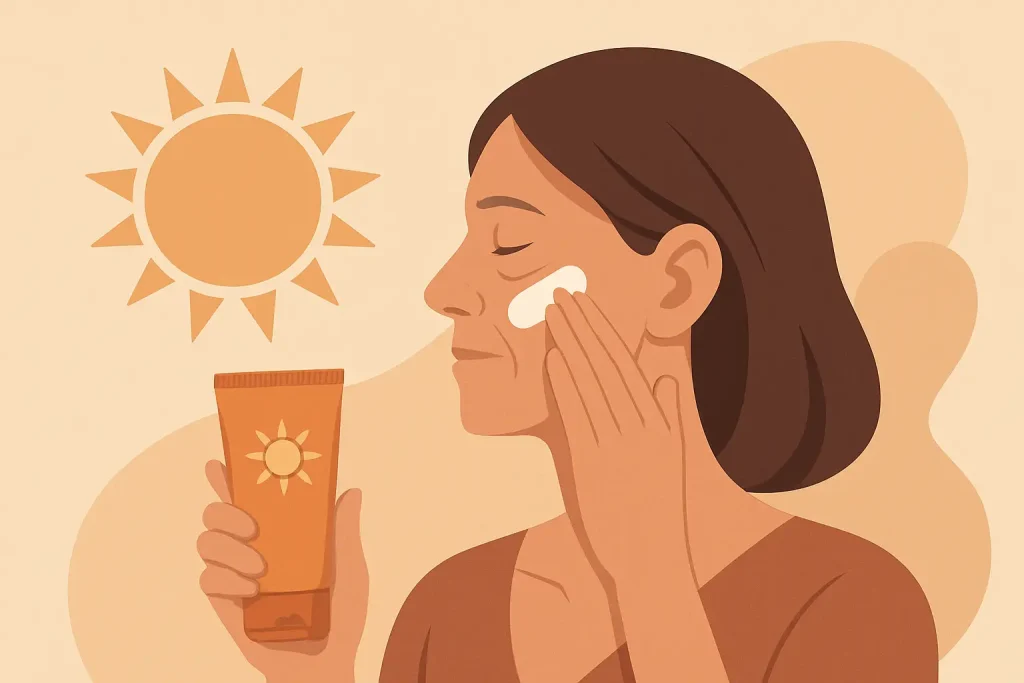
If you want the best sunscreen for photoaging prevention, you are not looking for a beach product. You are choosing a daily medical-grade behaviour that protects collagen, calms pigment activity, and keeps your results moving forward.
Why sunscreen is the single best anti-photoaging product
Photoaging is driven primarily by UVA, the wavelength range that penetrates deeper into the dermis, where collagen and elastin live. UVB is the main culprit for burning, but UVA is the quiet “ageing ray” that you can accumulate on cloudy days, through windows, and during short exposures that do not feel dramatic.
In clinic, we see a clear pattern: clients who wear a high-UVA sunscreen daily respond faster to corrective treatments and maintain results longer. Clients who are inconsistent often experience a frustrating cycle – pigment keeps reappearing, redness is easily triggered, and the skin barrier never quite stabilises.
Sunscreen is also the product that makes your active skincare safer. If you use retinoids, exfoliating acids, brightening ingredients, or you are doing any device-led programme, UV protection is not optional. It is the foundation that stops inflammation and pigment from becoming the dominant story.
What “best sunscreen for photoaging prevention” actually means
The best sunscreen is the one you will apply correctly, in the right amount, every day – and reapply when you genuinely need to. That said, there are non-negotiables if your goal is photoaging prevention rather than simply “not burning”.
Prioritise UVA protection, not just SPF
SPF measures UVB protection. It does not tell you how well the product protects against UVA-driven ageing.
In the UK, look for two things.
First, the UVA circle logo. That indicates the UVA protection is at least one third of the SPF.
Second, the star rating system (often 4 or 5 stars), which gives a sense of how balanced the UVA protection is compared to UVB.
For photoaging prevention, choose SPF 30 or SPF 50 with high UVA protection. If you are managing pigmentation, melasma, post-acne marks, or you are using vitamin A, many clients do best on SPF 50 day-to-day because it gives a bigger margin for real life.
Broad spectrum means more than marketing
“Broad spectrum” should mean both UVA and UVB, but it does not guarantee high UVA performance. Read the packaging and look for the UVA circle and star rating rather than relying on a headline claim.
Texture matters more than most people admit
If your sunscreen feels heavy, stings your eyes, pills under makeup, or makes you look grey, you will use less of it. And using half the recommended amount can reduce protection dramatically.
The best sunscreen for photoaging prevention is the one that fits your skin type and your daily routine.
If you are oily or congestion-prone, lean towards lightweight fluids or gel-creams with a modern, non-greasy finish. If you are dry or sensitised, you will usually do better with a creamier formula that supports the barrier and sits comfortably all day.
If you wear makeup, you need a sunscreen that behaves under it. The goal is not “perfect skincare theory”. The goal is consistent, correct application.
Mineral vs chemical filters: the real trade-offs
Sunscreens work using UV filters, and clients often ask whether mineral is “better”. The honest clinical answer is: it depends.
Mineral (inorganic) filters, typically zinc oxide and titanium dioxide, sit on the skin and reflect and scatter UV, with some absorption. They are often well tolerated by reactive skins and can be brilliant for post-procedure calm. The trade-off is cosmetic elegance. Some mineral formulas leave a white cast, feel thicker, or emphasise dryness.
Chemical (organic) filters absorb UV and convert it into a small amount of heat. Modern chemical filters can be extremely effective and far more wearable. The trade-off is that some people experience eye stinging or sensitivity, particularly if the skin barrier is compromised.
For photoaging prevention, what matters is not the category – it is high UVA protection plus a formula you can commit to daily.
Hybrid formulas are often the sweet spot
Many high-performance sunscreens combine mineral and chemical filters to balance wearability, tolerance, and strong UVA coverage. If you are struggling to find something you can wear daily, a hybrid is often where clients land.
How much sunscreen you actually need (and where people miss)
Most people under-apply. You might think you are protected because you used “a bit”, but SPF testing is done at a specific application amount.
A practical rule is two finger lengths of product for face and neck. If that sounds like too much, that is usually a sign the texture is not right for you. The answer is not to apply less; the answer is to choose a formula that you can apply properly.
Do not forget the hairline, ears, and the sides of the face near the temples – this is where we often see early pigment and texture change. Extend down onto the neck as standard. If you are serious about photoaging prevention, the neck is not an afterthought.
Reapplication: do you need to do it every two hours?
The “every two hours” rule is designed for sustained outdoor exposure, sweating, swimming, towel drying, and peak UV conditions.
For everyday life in Greater Manchester – commuting, office work, school runs, short walks – you may not need strict two-hourly reapplication if you applied properly in the morning and your exposure is limited.
But if you are outdoors at lunchtime, travelling, sitting by a bright window, exercising, or you have a history of pigmentation, plan to reapply. Think of it as protecting your investment in collagen and clarity.
If you wear makeup, reapplication can feel awkward. This is where tinted mineral sunscreens or powder mineral SPF can help top up, but they rarely replace a proper base layer applied in the correct amount. We want workable, not perfect.
Tinted sunscreen and iron oxides: a smart move for pigmentation
If you are prone to pigmentation, melasma, or post-inflammatory marks, consider tinted sunscreen. The reason is not cosmetic. Many tinted formulas contain iron oxides, which can help protect against visible light – a trigger that can worsen pigmentation in some skins.
The trade-off is shade matching. If the tint is wrong, you will avoid using it. If you find a match, it can be one of the most protective daily options for uneven tone.
Choosing the best sunscreen for photoaging prevention by skin concern
If you are acne-prone or congested
Look for “non-comedogenic” claims, but judge primarily by behaviour on your skin over 2 to 4 weeks. A lightweight, high-UVA fluid that does not leave a greasy film tends to support clearer pores.
Avoid using facial oils under sunscreen if you are actively breaking out. It can increase slip and reduce film integrity, and for some clients it simply adds to congestion.
If you are dry, sensitised, or using active vitamin A
Prioritise comfort and barrier support so you do not “skip days” when the skin feels tight. A moisturising sunscreen can be your daytime moisturiser, provided it sits well and you can apply enough.
If your skin stings when you apply sunscreen, treat that as information. It often points to barrier impairment, over-exfoliation, or an active skincare routine that needs rebalancing.
If you are managing pigmentation
High UVA protection is essential, and tinted options can be a strong addition. Also be realistic: one day of intense sun can re-ignite pigment pathways that take weeks to calm again. This is why we place sunscreen at the centre of pigmentation plans.
Sunscreen is only as good as your routine around it
Sunscreen should be the final step of your morning skincare. Apply it after your serums and moisturiser, and give it a few minutes to set before makeup.
If you are using exfoliating acids in the morning, consider moving them to evening. Many clients do better when the morning routine is calm, protective, and barrier-friendly, with actives reserved for night.
If you are unsure which filters your skin tolerates, or you are stuck in a cycle of pigment returning despite “good products”, a structured consultation can save you months of trial and error. At GRB Skin Clinic, we treat sunscreen as a prescription-level decision within a bigger plan – because preventing photoaging is not a single product, it is a disciplined system.
What to look for on the label (without getting lost)
Keep your selection criteria tight. For most clients focused on photoaging prevention, the best label cues are SPF 30 or 50, the UVA circle logo, a high star rating, and a finish you enjoy wearing.
If you have sensitive eyes, choose formulas labelled for the eye area or consider mineral-heavy options for the orbital region, applying carefully so the product does not migrate. If you train outdoors or sweat heavily, look for water resistance, but remember it still needs reapplication.
And if you only ever wear sunscreen on holidays, start with one simple non-negotiable: apply it every single morning, even when the forecast is grey. Your skin does not measure UV exposure by how sunny it looks.
A helpful closing thought: if you want skin that keeps its firmness, clarity, and even tone, make sunscreen feel as normal as brushing your teeth – not a seasonal accessory, but a daily commitment to your future face.