
Share This Post
You can keep booking waxing appointments every few weeks and building your routine around regrowth, or you can choose a plan designed to reduce hair over time. That is the real decision behind laser hair removal versus waxing. It is not simply about how hair is removed on the day. It is about what you want your skin to deal with month after month.
For some clients, waxing is familiar, fast and completely fine. For others, it becomes a cycle of irritation, ingrown hairs, sensitivity and constant maintenance. If your goal is long-term reduction, fewer inflammatory flare-ups and a more structured route to smoother skin, laser often becomes the stronger option. But the right answer depends on your hair type, skin behaviour, budget and expectations.
Laser hair removal versus waxing: what is the actual difference?
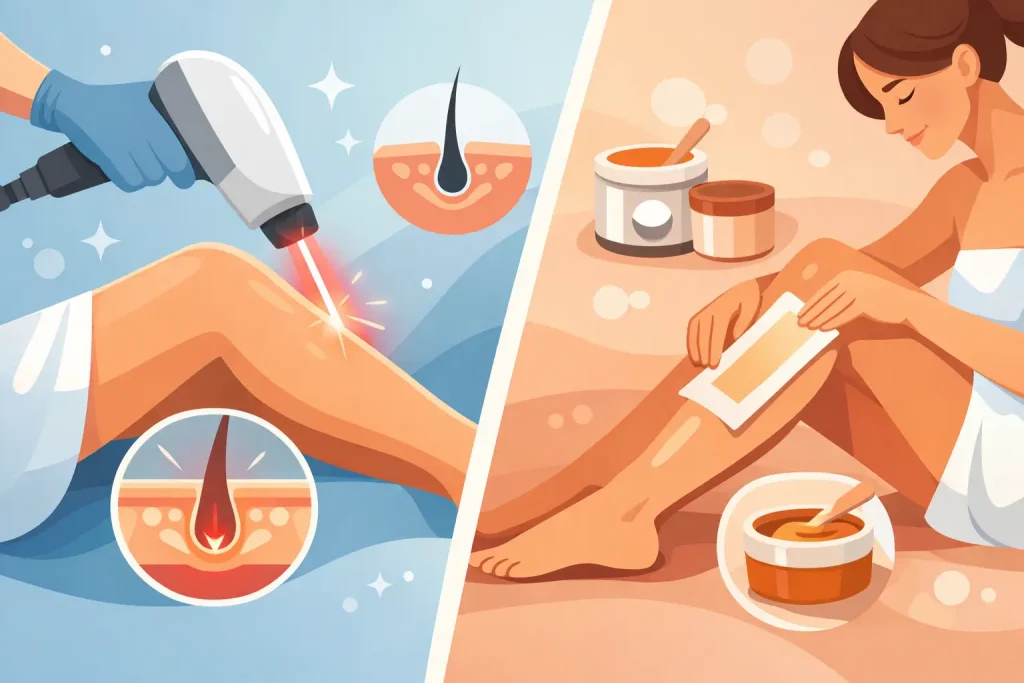
Waxing removes the hair from the root using warm or hot wax. The follicle remains active, which means the hair grows back and the treatment must be repeated regularly. Depending on the area and your growth cycle, that may mean every three to six weeks.
Laser hair removal works very differently. It targets pigment in the hair follicle with controlled light energy, heating the follicle to disrupt future growth. Hair does not disappear forever after one session. It reduces progressively over a course of treatments because hair grows in cycles and laser is most effective at the right stage of growth.
That distinction matters. Waxing is a temporary hair-removal method. Laser is a long-term hair-reduction treatment plan.
Which gives better long-term results?
If by better you mean longer-lasting, lower-maintenance results, laser usually wins. After a full course, many clients see a significant reduction in hair density, slower regrowth and finer hairs. The skin can also feel calmer because there is less repeated pulling, less friction from regrowth and often fewer ingrown hairs.
Waxing can leave the skin smooth for a few weeks, but the cycle restarts quickly. You still need the hair to regrow enough before your next appointment, which means living with the in-between stage. For clients who are tired of planning holidays, gym sessions or special occasions around hair growth, that can become frustrating.
There is a trade-off, though. Laser requires commitment upfront. You need a treatment course, spacing between sessions and occasional maintenance. If you want a single one-off treatment before an event, waxing may suit that short-term need better.
Cost: cheaper now or better value over time?
This is where many people hesitate. Waxing often looks cheaper because each appointment costs less than a laser session. But the maths changes when you stretch it over years.
A client who waxes underarms, bikini and lower legs regularly may spend a substantial amount across 12 months, then repeat that again the following year, and the year after that. Laser is more of an investment at the start, but for many clients it becomes better value over time because the need for ongoing appointments drops significantly.
Cost also needs to be measured against skin outcomes. If waxing repeatedly triggers spots, ingrown hairs or post-inflammatory pigmentation, especially in areas such as the bikini line, underarms or jawline, the price is not just financial. You may also be managing discomfort, marks and reduced confidence.
A proper consultation should always look beyond the ticket price and assess what your skin is coping with.
Pain and comfort: which feels worse?
There is no universal answer because pain tolerance varies, the treatment area matters and equipment quality makes a difference. Most clients describe waxing as a sharp, immediate pull. Laser tends to feel more like a quick snap of heat or an elastic-band flick.
The important point is repetition. With waxing, you experience that pull every time you return, indefinitely. With laser, sessions are spaced out and the long-term aim is less hair and less need for treatment. Many clients feel that even if laser is not completely pain-free, it is more worthwhile because it is working towards a reduction rather than resetting the same cycle.
Modern devices and skilled practitioner technique also make a difference. A clinical setting should assess settings carefully, monitor skin response and adjust treatment according to your skin tone, hair colour and sensitivity. That level of precision is not the same as simply removing visible hair.
Skin response: sensitivity, ingrowns and pigmentation
This is often the deciding factor.
Waxing can work well for many people, but it can also aggravate reactive skin. Repeated traction on the skin may leave some clients red, sore or broken out, especially if the area is already prone to congestion or folliculitis. Ingrown hairs are also common because the new hair may struggle to emerge cleanly through the skin surface.
Laser hair removal can be transformative for clients who regularly deal with ingrown hairs. By reducing the amount and thickness of regrowth, it often helps break that cycle. It may also reduce the repeated trauma that contributes to dark marks after inflammation.
That said, laser is not suitable to perform casually or without screening. Skin tone, medical history, sun exposure, medications and the presence of active irritation all matter. A specialist clinic should assess whether your skin is a good candidate, explain pre- and post-care properly, and set realistic expectations from the outset.
Is laser suitable for everyone?
No, and that is exactly why consultation matters.
Laser tends to work best where there is enough contrast between the pigment in the hair and the surrounding skin, although advances in professional technology mean a wider range of skin tones can now be treated safely when protocols are selected correctly. Grey, white, red and very fair blonde hairs are usually less responsive because there is not enough pigment for the laser to target effectively.
Waxing, by contrast, can remove most hair colours because it does not rely on pigment. So if your hair is too light for laser, waxing may remain the practical option.
This is where honest assessment is essential. No credible practitioner should oversell laser to someone who is unlikely to get a strong result.
What about timing, convenience and preparation?
Waxing gives an immediate result, but it requires regrowth before every appointment. You cannot be perfectly smooth all the time if waxing is your maintenance method, because the hair needs to be visible enough to remove.
Laser works the other way round. You usually shave before treatment, and over the course of your sessions the hair becomes sparser and easier to manage. Appointments are often spaced several weeks apart, depending on the area being treated.
There are practical restrictions with laser. You need to be mindful of tanning, sun exposure and certain active products depending on the area. You also need consistency. Missing sessions or stopping halfway through a course can affect your result. For clients who like structure and are prepared to follow a plan, this usually feels manageable. For those who want complete spontaneity, waxing may feel simpler.
Laser hair removal versus waxing for intimate areas
Bikini and underarm areas are where the difference often becomes most obvious. These are high-friction zones, and they are common sites for ingrown hairs, shaving rash, post-inflammatory marks and tenderness after hair removal.
Waxing can keep the area smooth temporarily, but if you are already struggling with bumps, trapped hairs or pigmentation, repeated waxing may not be helping as much as you think. Laser can be particularly beneficial here because long-term reduction means less repeated trauma to the area.
However, intimate-area laser must be carried out professionally, with strong hygiene standards, clear consent, thorough patch testing where required and careful setting selection. This is not an area for guesswork.
So which should you choose?
Choose waxing if your priority is short-term hair removal, your hair is too light for laser, or you are not ready to commit to a course of treatment.
Choose laser if you are looking for a longer-term strategy, you are tired of constant upkeep, or your skin is repeatedly reacting to waxing and regrowth. For many adults wanting a cleaner, calmer and more efficient maintenance routine, laser is the more progressive choice.
At GRB Skin Clinic, that decision should never be made on marketing alone. It should be made through proper assessment of your skin, hair, history and goals, with a treatment plan that respects both results and skin health.
The best hair-removal choice is the one that fits your biology, not just your diary. If you are weighing up convenience against long-term change, start by asking a better question: do you want another appointment, or do you want a plan?