
Share This Post
If you are tired of planning your week around regrowth, the real question is not which method removes hair fastest today. It is which option fits your skin, hair pattern, pain tolerance and long-term goals. When clients ask us about laser hair removal vs epilator, they are usually deciding between convenience now and reduction over time.
Both methods remove hair from the root or target the follicle, so both can leave skin smoother than shaving. That is where the similarity ends. One is a home device-based routine that needs repeating frequently. The other is a structured clinical treatment plan designed to progressively reduce hair growth. Choosing well means looking beyond the first result and thinking about what your skin will still be dealing with in three, six and twelve months.
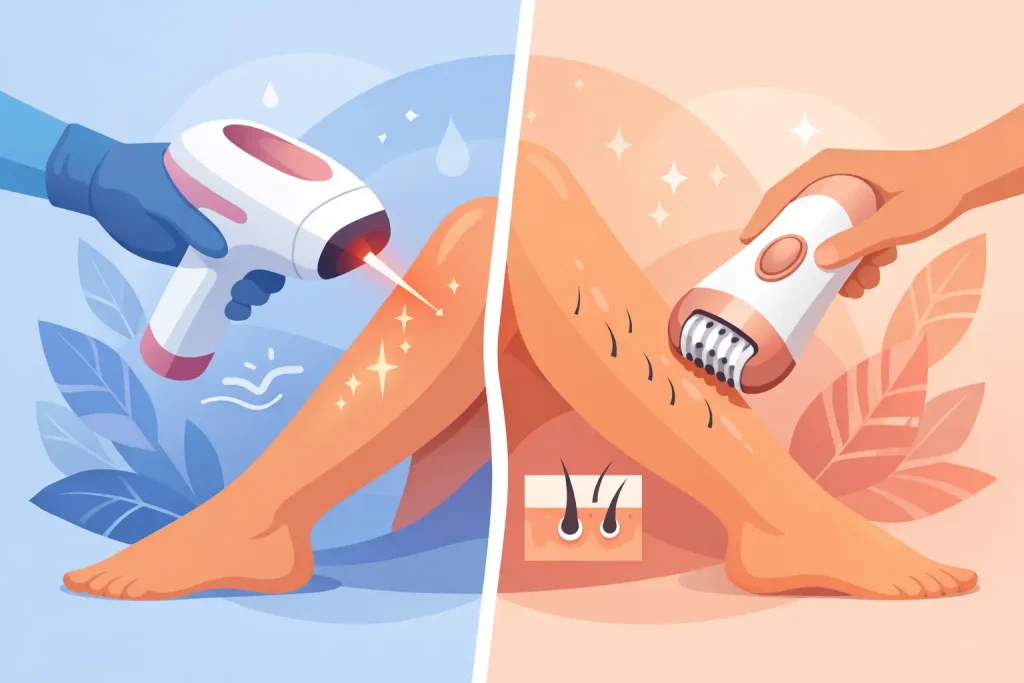
Laser hair removal vs epilator: the core difference
An epilator mechanically pulls multiple hairs out from the root using rotating tweezers or discs. It does not change how the follicle behaves, so the hair grows back and the cycle continues. You repeat the process every couple of weeks, sometimes sooner depending on the area and your growth rate.
Laser hair removal works differently. It uses light energy to target pigment in the hair and disrupt the follicle’s ability to produce new growth. Hair grows in cycles, which is why treatment is carried out as a course rather than a one-off session. Over time, and with the correct intervals, many clients see a significant reduction in hair density, slower regrowth and finer remaining hairs.
This distinction matters because it affects everything else: discomfort, maintenance, cost over time and how your skin responds.
What results can you realistically expect?
If your goal is smooth skin for a week or two, an epilator can do that. It is practical for people who do not mind regular maintenance and are comfortable managing the process themselves. Some people like the control of home use, especially for lower legs or underarms.
If your goal is long-term reduction, an epilator will not give you that outcome. It removes what is visible, then the follicle carries on. Laser is the stronger choice for clients who are done with constant upkeep and want a treatment plan that produces cumulative change.
That said, laser is not instant. It requires commitment to a full course and occasional maintenance sessions. It is also most effective when the hair contains enough pigment for the light to target it well. Grey, white and some very fair hairs tend to respond poorly.
This is where proper consultation matters. A clinician should assess hair colour, skin tone, medical history and treatment goals before recommending a course.
Pain, sensitivity and skin response
There is no honest way to compare these methods without talking about discomfort. Epilation can be quite painful, particularly on sensitive areas such as the bikini line, underarms and face. Because the hairs are being pulled out individually and repeatedly, many people also experience temporary redness, sensitivity and ingrown hairs.
Laser hair removal is often described as a sharp flicking sensation with warmth. The level varies by area, hair density and the technology being used. For many clients, it is more tolerable than repeated epilation, especially because each session is part of a bigger plan rather than a never-ending routine.
From a skin health perspective, repeated trauma matters. Epilation can aggravate follicles and sometimes worsen post-inflammatory marks, particularly in skin that is already prone to pigmentation or ingrowing hairs. If you are managing sensitivity, acne-like folliculitis or pigment concerns, aggressive home hair removal can make things harder to control.
Laser needs to be delivered correctly and safely, but when managed by an experienced practitioner it can actually reduce the cycle of irritation caused by constant pulling, shaving and trapped hairs.
Cost: cheaper upfront or better value long term?
This is often where people hesitate. An epilator costs less at the start. You buy the device once and use it at home. On paper, that feels economical.
But low upfront cost is not the same as value. Epilation requires your time, repetition and tolerance of regrowth forever. If you are treating larger areas for years, the true cost includes the ongoing effort, replacement heads or devices, and the fact that your result never really progresses.
Laser hair removal costs more initially because it is a professional treatment course. However, it is designed to reduce the burden over time. For many clients, that means fewer ingrown hairs, less visible regrowth, less daily planning and a noticeable improvement in how the skin feels and looks between sessions.
If you are only looking for a short-term solution, an epilator may make sense. If you are looking for a reduction strategy, laser is usually the better investment.
Which option is better for different body areas?
Lower legs are where many people first try an epilator because the area is accessible and the skin is generally less delicate. Even then, the experience varies. Coarser hair can make the process more uncomfortable, and missed patches are common if you rush.
Underarms and bikini areas are usually where the limits of epilation become obvious. These zones are sensitive, hair can be coarse, and ingrowing hairs are common. For clients prone to bumps, inflammation or pigmentation after hair removal, laser is often the more intelligent long-term option.
Facial hair is a more careful conversation. Epilating the face can irritate the skin, particularly if you are using active skincare or managing sensitivity. Laser may be appropriate in some cases, but facial hair in women can be hormonally influenced, and treatment planning needs more nuance. Hormonal patterns, underlying medical factors and hair type all affect the likely outcome.
Skin tone, hair colour and safety
Laser is not one-size-fits-all. Safe and effective treatment depends on matching the correct device settings and protocol to your skin tone and hair characteristics. This is why clinical assessment should never be skipped.
Epilators do not rely on pigment, so in that sense they can be used across hair colours and skin tones. But that does not automatically make them the better choice. Mechanical removal still carries a risk of irritation, particularly in darker skin tones that are more vulnerable to post-inflammatory pigmentation after trauma.
With laser, the advantage is precision – if the treatment is being delivered by a trained practitioner with the right technology and a proper understanding of skin behaviour. This is also why bargain-led decisions can backfire. Hair removal is not just about removing hair. It is about preserving the condition of the skin while doing it.
Lifestyle and maintenance
An epilator suits people who do not mind building hair removal into their routine. If you are happy doing touch-ups regularly and your skin copes well, it can be workable. It is portable, private and immediate.
Laser suits people who want structure and a finish line. You attend sessions at set intervals, follow the aftercare and gradually move into less maintenance. That appeals to clients who are tired of reactive beauty routines and would rather commit to a plan with a measurable outcome.
This is often the biggest difference in mindset. One option keeps the task on your list. The other aims to reduce the task itself.
So which should you choose?
The answer depends on whether you want temporary removal or long-term reduction. If you have a limited budget, low sensitivity and do not mind frequent upkeep, an epilator may be sufficient. It is a tool, not a treatment plan.
If you are prone to ingrown hairs, persistent irritation, pigmentation after hair removal or simply want to stop managing regrowth so often, laser is usually the stronger option. It asks for more commitment at the start but offers a very different return.
For many adults, especially professionals balancing work, skin confidence and personal maintenance, laser makes more sense because it aligns with a results-led approach. It treats hair reduction as a process, not a repeated chore.
At GRB Skin Clinic, that is how we view all advanced treatments – through the lens of skin health, suitability and realistic outcomes. The best choice is not the one that sounds quickest. It is the one that supports your skin properly and moves you closer to less maintenance, less irritation and more confidence in your day-to-day routine.
If you are still weighing up laser hair removal vs epilator, start by asking a better question: do you want to keep removing hair, or do you want to reduce the need to keep thinking about it?