
Share This Post
If you are eager to start treatment, the patch test can feel like a delay. In reality, a proper laser hair removal patch test guide should show you that this small first step is what makes the rest of the plan safer, more precise and far more likely to deliver the result you want.
At a specialist clinic, the patch test is not a formality. It is a clinical checkpoint. It allows your therapist to assess how your skin responds to a specific laser setting before a full treatment area is covered, and it helps rule out avoidable irritation, pigment disruption and poor treatment choices. For clients who want long-term hair reduction rather than rushed appointments, this matters.
Why a patch test matters before laser hair removal
Laser hair removal works by targeting pigment in the hair follicle with light energy. That sounds straightforward, but real skin is never one-size-fits-all. Skin tone, hair density, hair colour, recent sun exposure, active skincare, medication, hormonal influences and the area being treated can all affect how skin responds.
A patch test gives your practitioner a controlled way to observe that response. Instead of making assumptions, they can see whether the chosen settings are appropriate for your skin and hair combination. That is especially important if you have more reactive skin, a history of pigmentation, recent tanning, or if you are treating hormonally influenced areas such as the face.
It also protects treatment quality. Settings that are too cautious may keep things comfortable but produce weak results. Settings that are too aggressive can create unnecessary inflammation and increase risk. The patch test helps find the balance between safety and effectiveness.
What happens at a laser hair removal patch test
A good laser hair removal patch test guide should prepare you for more than a quick flash of light. In a clinical setting, this appointment usually begins with consultation. Your therapist will ask about your medical history, medications, skin history, previous hair removal methods, sun exposure and treatment goals. They may also ask about active ingredients in your skincare if the area includes the face or neck.
The skin is then assessed. Your practitioner is looking at tone, sensitivity, signs of irritation, recent shaving or waxing history, and whether the hair in that area is likely to respond well. Laser typically works best on darker hair because the device needs pigment to target. Very fair, grey, white or red hair may not respond in the same way, and a responsible clinic should tell you that clearly.
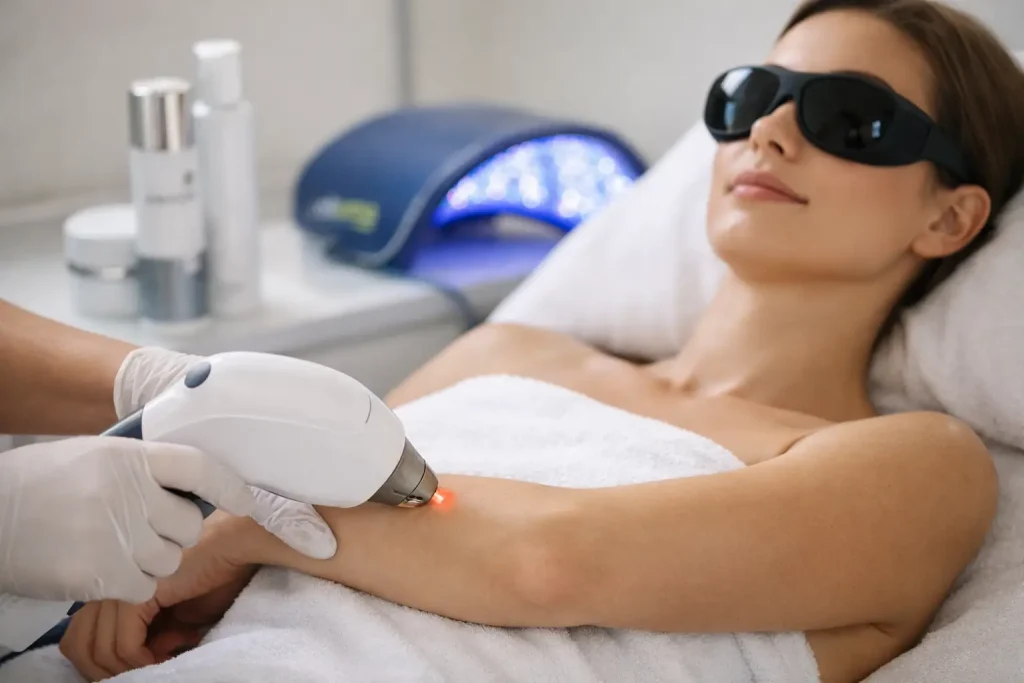
Once the area has been cleansed and prepared, a small section is treated using carefully selected settings. You may feel warmth, a light snapping sensation or momentary discomfort, but it should be brief and manageable. The immediate response is then checked. Mild redness around the follicles is often expected. That can be a reassuring sign that the follicle has responded.
In some cases, your practitioner may test more than one setting if clinically appropriate. This gives a better picture of which approach your skin tolerates best and which is most suitable for future sessions.
What you should do before the patch test
Preparation affects the value of the test. If you arrive with skin that has been recently tanned, irritated or sensitised, the result may not reflect how your skin should be treated under ideal conditions.
The area usually needs to be shaved beforehand unless your clinic advises otherwise. Hair should be present in the follicle under the skin, but not sitting long above the surface. Avoid waxing, threading or plucking in the lead-up to the appointment because these methods remove the follicle target the laser needs.
You should also avoid excessive sun exposure and fake tan before testing. Tanned skin contains more pigment, which can change how the laser interacts with the area and increase the risk of unwanted skin reaction. If you use retinoids, exfoliating acids or other active products on a facial area being tested, your practitioner may ask you to pause them for a period beforehand.
This is also the time to be honest about medication and health changes. Certain antibiotics, acne medications and photosensitising treatments can affect suitability. A patch test only protects you properly if the information behind it is accurate.
What to expect after a patch test
Straight after the test, the skin may look slightly pink or feel warm, similar to mild heat in the area. That often settles within hours, though some clients may notice sensitivity for a little longer depending on the area and their skin behaviour.
Your therapist should tell you what normal post-test responses look like and what would be considered excessive. You may be asked to wait 24 to 72 hours, and sometimes longer, before full treatment so the clinic can assess delayed reactions. This matters because not every response appears instantly. Pigment shifts, prolonged irritation or unusual sensitivity can develop later.
During that window, keep the area calm. Avoid heat treatments, vigorous exercise immediately afterwards if advised, and anything that could further irritate the skin. Sun protection is important, particularly if the tested area is exposed.
If the skin settles as expected, your practitioner can move forward with much more confidence. If it does not, that is useful information too. It may mean the settings need adjusting, the treatment timing needs changing, or laser may not be the right option at that moment.
When a patch test becomes even more important
Every client should have one, but some situations make it particularly valuable. If your skin tone is deeper, if you are prone to post-inflammatory pigmentation, if you have recently been in the sun, or if you are treating the face, underarms or bikini line, skin response can be more variable.
The same applies if you have had laser elsewhere before and assume all systems behave the same way. They do not. Different devices, pulse durations, cooling systems and practitioner approaches can all change the experience. A previous successful course does not remove the need for testing with a new clinic or machine.
Hormonal hair growth also deserves realistic discussion. Areas affected by hormonal changes, such as the chin or jawline, can respond well but may require more sessions and maintenance. A patch test will not predict your entire long-term outcome, but it helps establish whether the skin can be treated safely and whether the early response is encouraging.
What a good clinic is really assessing
A patch test is not just about whether the skin goes red. An experienced practitioner is looking at several layers at once. They are assessing follicular response, epidermal reaction, your comfort level, your skin history and whether your expectations match what the technology can realistically deliver.
This is where specialist care makes a difference. In a consultation-led clinic, the patch test sits inside a bigger treatment plan. Your therapist is not only deciding if they can treat you, but how they should treat you across a course of sessions, how your skin should be supported between appointments, and when treatment should be postponed rather than pushed through.
That clinical judgement is especially important for clients who already invest in their skin and want to avoid setbacks. If you are managing pigmentation, sensitivity or facial skin health more broadly, laser hair removal should be fitted around that, not treated as a separate cosmetic add-on.
Questions worth asking at your patch test
You do not need to know the technical detail of every wavelength to make a good decision, but you should leave the appointment with clarity. Ask how many sessions are likely for your area, what results are realistic for your hair type, how long you need between appointments, and what could delay treatment.
It is also sensible to ask what signs of normal response look like after testing, what aftercare you should follow, and when to report a reaction. A trustworthy practitioner will answer directly. They will not overpromise, and they will not rush you past the parts that protect your skin.
If the consultation feels vague, if little attention is paid to your medical history, or if treatment is offered without proper assessment, take that seriously. Laser is highly effective when used well, but it is still an advanced treatment and should be approached with the same respect you would expect from any device-led skin procedure.
The patch test is the start of the result
Clients often think the treatment begins with the first full session. Clinically, it begins earlier. The patch test is where safe settings, skin behaviour and realistic planning come together. It sets the standard for everything that follows.
At GRB Skin Clinic, that step matters because results are built through structure, not guesswork. If you want laser hair removal done properly, the patch test is not the obstacle before progress. It is the first sign that your treatment is being led with care, precision and respect for your skin.
The best aesthetic decisions usually feel less dramatic at the start than people expect. They feel measured, informed and well judged, and that is often exactly why they work.