
Share This Post
If you have ever looked at your skin a week after laser and thought, “Shouldn’t more of the hair be gone by now?”, you are asking exactly the right question. A realistic laser hair removal results timeline example helps you understand what is normal, what is promising, and why visible change happens in stages rather than all at once.
Laser hair removal is not a one-visit fix. It is a structured treatment course that targets hair in the right growth phase, over time, with carefully spaced sessions. That is why a proper consultation matters. Hair density, hormonal influence, skin tone, hair colour, treatment area, and the quality of the device all affect how quickly you see change.
A laser hair removal results timeline example
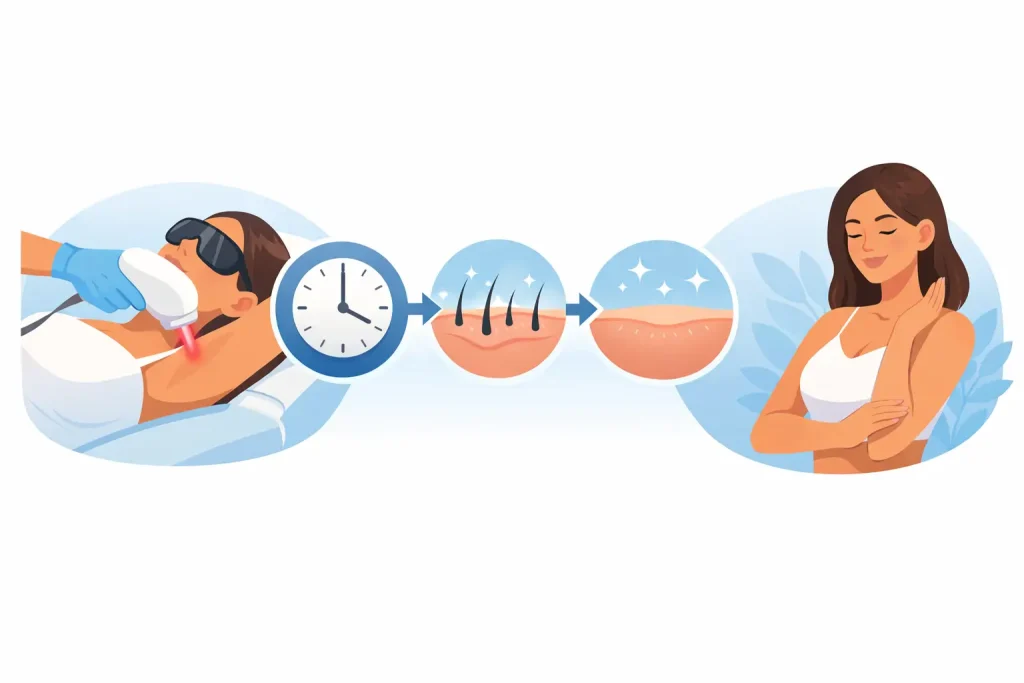
For most clients, the first thing to understand is that results are progressive. You are not watching every hair vanish instantly. You are watching the amount of active regrowth reduce, the texture of the regrowth soften, and the time between shaves or wax appointments stretch out.
A typical timeline for underarms, bikini, lower legs, or facial areas might look like this.
After session 1
In the first 24 to 72 hours, the area may feel warm or slightly sensitive, rather like mild sun exposure. Some clients notice redness around the follicles. This is often a normal response and usually settles quickly.
Over the next one to three weeks, treated hairs begin to shed. This is where expectations often go wrong. Those hairs do not always fall out overnight. They can look as if they are still growing, when in fact the body is pushing them out. You may notice patchiness rather than a smooth, complete clearance.
At this stage, many clients still feel they need to shave. That does not mean the treatment has failed. It usually means you are in the early part of the process.
After session 2
By the second treatment, you will often start to see a more useful pattern. Hair may come back slower. Some patches may be significantly finer. Other patches may still look stubborn because not every follicle was in the right growth phase during the first appointment.
This is one of the reasons treatment intervals matter. If sessions are too close together or too far apart, results can become less consistent. A therapist-led plan is designed to catch more follicles during the anagen, or active growth, phase, when laser is most effective.
After session 3
This is often the point where clients feel encouraged. Regrowth is usually less dense, and shaving becomes less frequent. On underarms and bikini lines, many people notice a meaningful reduction by this stage. On hormonally influenced areas such as the face, progress may still be visible but slower.
You may also notice that the hair that does return feels less coarse. That matters. Reduction is not only about quantity. It is also about quality of regrowth.
After sessions 4 to 6
For many clients, this is where the treatment course starts to feel transformative. Areas that once needed constant maintenance may stay smoother for much longer. Ingrown hairs often improve. Skin can look calmer simply because there is less repeated shaving, plucking, or friction.
That said, this is also the stage where the last resistant hairs become more obvious. A course can reduce the majority of unwanted growth, but finer or lighter hairs may respond differently. Some clients need additional sessions, particularly on facial areas, intimate areas, or any zone affected by hormones.
After sessions 6 to 8 and beyond
At the later end of a course, the aim is usually refinement and long-term control. Many clients achieve substantial reduction, but maintenance can still be needed. Laser hair removal is best understood as long-term hair reduction, not a guarantee that no hair will ever return.
Life changes can also affect results. Hormonal shifts, pregnancy, perimenopause, medications, and some health conditions can stimulate dormant follicles. That does not cancel your progress, but it may mean top-up treatments are sensible.
Why your results may not match someone else’s timeline
A laser hair removal results timeline example is useful, but it is still only an example. Real skin and real hair do not behave like a chart.
Hair colour is one major factor. Darker, coarser hair tends to respond best because it contains more pigment for the laser to target. Very fair, grey, red, or white hair can be more difficult to treat effectively. Skin tone matters too, because settings must be selected with precision to treat safely while still delivering enough energy to the follicle.
Treatment area also makes a difference. Underarms often respond well and relatively quickly. Legs can do well, but they may need patience because of the size of the area and variations in hair cycles. Facial hair can be more complex, particularly where there is an underlying hormonal driver. In those cases, a longer treatment plan may be realistic and appropriate.
Then there is consistency. Missed sessions, shaving methods that irritate the skin, sun exposure before treatment, or products that make skin more reactive can all interfere with progress. Good results come from a course, not just a machine.
What “good progress” actually looks like
Clients often judge laser too early by asking whether the area looks hair-free immediately after treatment. A better way to judge progress is by looking at these changes over time.
The regrowth becomes slower. The hair becomes softer or finer. Patchy areas stay clear for longer. The need to shave reduces. Follicle inflammation settles. Skin texture can appear more even because there is less ongoing trauma from other hair removal methods.
That is a more clinically useful way to assess results than expecting every hair to disappear after one or two visits.
What can delay or limit results?
The most common issue is unrealistic timing. If you start treatment just before a holiday or a major event, you may be disappointed if you expect complete clearance within a few weeks. Laser works with biology, not with deadlines.
Hormonal imbalance can also make progress slower. Conditions linked with increased hair growth may require a more strategic plan and occasional maintenance. This is not a reason to avoid treatment. It is simply a reason to approach it with proper expectation-setting.
Another factor is the quality of consultation. A specialist clinic should assess your skin, hair, medical history, sun habits, and treatment goals before your course begins. That reduces the risk of poor outcomes and helps create a schedule that suits your skin rather than forcing you into a generic package.
How to support better results between sessions
The best laser outcomes usually come from clients who follow instructions carefully. Avoiding sun exposure, keeping the area protected, shaving when advised rather than waxing or plucking, and turning up on time for scheduled sessions all matter.
Skin health matters as well. Calm, well-supported skin tends to tolerate treatment better. If the barrier is compromised, irritated, or repeatedly sensitised, treatment may need to be adjusted. This is where a clinical approach makes a difference. Good practitioners are not only chasing hair reduction. They are protecting the skin while they do it.
At GRB Skin Clinic, that consultation-first mindset is central to achieving results that are both visible and safe. It is not about rushing through appointments. It is about building a treatment plan that respects your skin biology and gives the course time to work properly.
When should you expect to feel confident in the result?
Most clients feel they can clearly see progress by the third session, and stronger reduction by the fourth to sixth. The exact point depends on the area and the individual. If you are treating underarms or bikini, confidence often comes sooner. If you are treating the face or a hormonally active area, patience tends to be more important.
The key is to look for a trend, not a miracle moment. If the hair is returning more slowly, more sparsely, and more softly, the course is moving in the right direction.
Laser hair removal rewards consistency, realistic expectations, and expert guidance. Give it the structure it needs, and the timeline starts to make sense – not as a promise of instant perfection, but as a clear path towards smoother, lower-maintenance skin.