
Share This Post
If you are tired of shaving, dealing with ingrown hairs, or booking endless waxing appointments, the real question is not whether to invest in hair reduction – it is which technology will actually give you the best long-term result. When clients ask about laser hair removal vs IPL, they are usually trying to separate marketing claims from clinical reality.
This matters, because the wrong choice can mean slower progress, more maintenance, unnecessary irritation, or disappointment after spending months on treatment. Hair reduction is not just about convenience. For many people, it is also about skin health, confidence, and reducing chronic problems such as folliculitis, shaving rash, and post-inflammatory pigmentation.
Laser hair removal vs IPL: the core difference
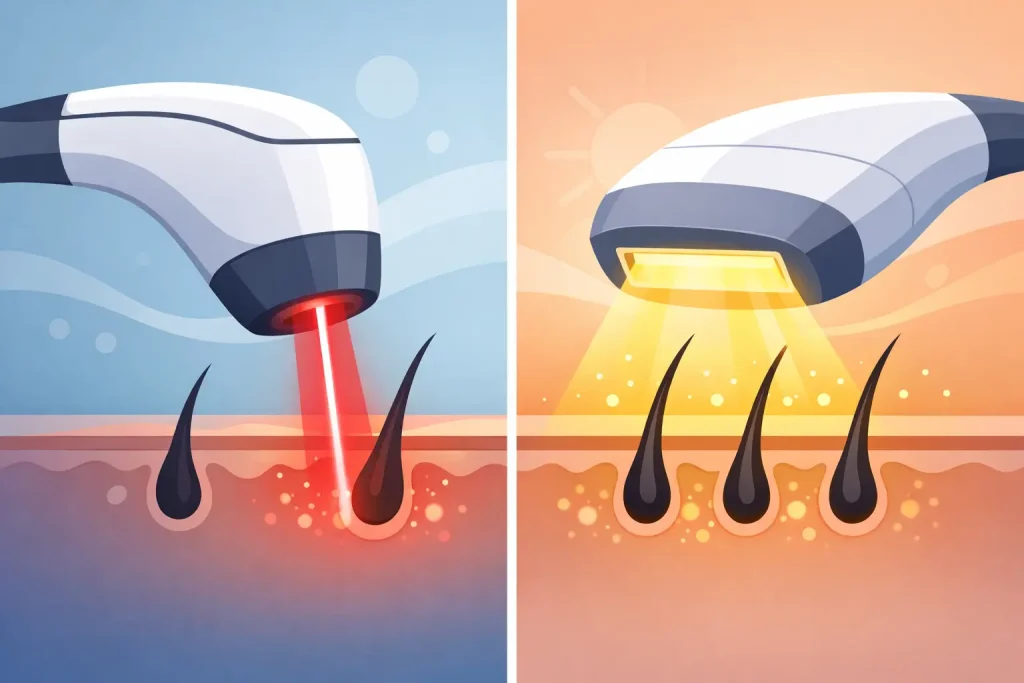
Although these treatments are often grouped together, they are not the same thing. Laser hair removal uses a concentrated single wavelength of light that targets melanin in the hair follicle with much greater precision. IPL, which stands for intense pulsed light, uses a broad spectrum of light with multiple wavelengths dispersed over the skin.
That difference affects everything – how efficiently the energy reaches the follicle, how predictable the result is, and how suitable the treatment may be for different skin tones and hair types. In simple terms, laser is a more targeted medical-grade approach. IPL is broader and generally less specific.
From a clinical point of view, precision matters. The more selectively the device can focus on the hair follicle while protecting the surrounding skin, the better the treatment tends to perform. This is one reason professional laser courses are often favoured for clients who want structured, measurable improvement rather than casual maintenance.
Which gives better results?
In most cases, laser hair removal gives stronger and more consistent long-term hair reduction than IPL. Because the beam is focused, it can deliver energy more effectively to the follicle and disrupt future growth more reliably over a course of sessions.
IPL can still reduce hair, particularly on lighter skin with dark hair, but it often requires more treatments and may leave clients needing more frequent top-up sessions. Some people do see worthwhile improvement with IPL, but the result is usually less decisive.
Hair grows in cycles, so neither treatment works on every hair at the same time. That is why a course is always needed. However, the efficiency of each session matters. If a device is not reaching the follicle with enough precision, you may find yourself committing more time and money for a softer outcome.
For clients who want a proper treatment plan and not a temporary reduction in regrowth, laser is usually the stronger option.
Skin tone and hair colour change the answer
This is where a consultation becomes essential. No ethical practitioner should promise the same result to every client, because hair reduction depends heavily on contrast between the hair and the skin.
Traditionally, both laser and IPL work best when the hair is dark and the skin is lighter, because the device is targeting pigment in the follicle. Darker, coarser hair tends to respond very well. Very fine, blonde, red, grey, or white hairs are much harder to treat because there is less melanin for the light to target.
When comparing laser hair removal vs IPL for darker skin tones, laser systems with the right technology and correct settings are generally the safer and more effective route. IPL can carry a higher risk of unwanted heating in the surrounding skin if used inappropriately. That does not mean every laser is suitable for every skin type, but it does mean device selection and practitioner expertise are critical.
This is exactly why clinic-led treatment is not interchangeable with a quick beauty add-on. Skin assessment, medical history, medication review, tanning habits, and patch testing all influence safety and results.
What does treatment feel like?
Most clients describe laser as a quick snapping sensation, often compared to an elastic band against the skin. Some areas are more sensitive than others, especially the bikini line, upper lip, and underarms. Modern devices often include cooling systems, which can make a significant difference to comfort.
IPL is sometimes described as gentler, but that is not always a benefit. Lower intensity or less targeted energy may feel more tolerable in some cases, yet it can also mean the treatment is less effective. Comfort should never be the only measure of quality.
A well-managed laser treatment should be fast, controlled, and clinically monitored. Mild redness around the follicles is common and often a sign that the skin has responded appropriately. What matters is not whether there is some sensation during treatment, but whether the protocol is suitable for your skin and the outcome justifies the course.
How many sessions will you need?
This is where honest expectation-setting matters. Neither laser nor IPL is a one-off fix. Most clients need a series of treatments spaced over several months because only hairs in the active growth phase can be effectively treated.
With professional laser hair removal, many clients begin to notice slower, finer, patchier regrowth after the first few sessions, with more significant reduction as the course progresses. IPL can also show progress, but the response is often slower and less uniform.
Hormones can influence the timeline. Areas such as the face can be more hormonally driven, meaning they may need more sessions and occasional maintenance even after a successful course. Conditions such as PCOS can also affect regrowth patterns. That does not mean treatment is not worthwhile. It simply means the plan must be realistic.
A trustworthy clinic will explain this from the beginning rather than overselling the easiest-case scenario.
Cost: cheaper upfront does not always mean better value
IPL is often marketed as the budget-friendly option, particularly through home-use devices or lower-cost salon offers. On paper, that can sound appealing. But upfront cost is only one part of the decision.
If you need more sessions, get a weaker result, or continue paying for frequent maintenance, the lower starting price can become less attractive over time. Laser hair removal usually costs more per session, but if the reduction is stronger and the treatment path is more efficient, it can offer better value overall.
There is also the cost of getting it wrong. If the wrong device is used on the wrong skin type, you are not just risking poor results. You may also trigger irritation or pigmentation concerns that then need correction.
For clients who care about long-term skin health as much as convenience, value should be judged by outcome, safety, and predictability – not just headline price.
Clinic treatment vs at-home IPL
Home IPL devices have become very popular, but they should not be confused with professional treatment. Their energy output is much lower, which is partly why they are considered safer for unsupervised use. It is also why results are usually more modest and depend heavily on consistency.
Some people use home IPL for maintenance after a professional course. Others buy a device hoping to replace clinic treatment entirely, then become frustrated when regrowth continues. For small areas and suitable candidates, home use can play a role. But for more significant reduction, coarse growth, ingrown hairs, or persistent shaving-related irritation, professional assessment and treatment are usually the more effective route.
A therapist-led protocol also gives you something a device at home cannot: judgement. Settings can be adjusted, skin reactions can be monitored, and the plan can evolve based on your response.
Who should choose laser, and who might choose IPL?
If you want the most effective and structured option, laser is usually the better choice. It suits clients who are looking for longer-term reduction, have coarse dark hair, or want treatment led by a practitioner who understands skin behaviour, contraindications, and realistic timelines.
IPL may appeal to clients with a tighter budget, lighter skin and dark hair, or those who are comfortable with a slower, less precise approach. It can be a reasonable option in some cases, but it is rarely the gold standard when clinical results are the priority.
The real answer is not about choosing the trendier treatment. It is about choosing the one that matches your skin, hair, goals, and willingness to commit to a proper course.
The best choice starts with assessment, not assumption
Hair removal should never be treated as one-size-fits-all. The right technology depends on skin tone, hair thickness, treatment area, hormonal influences, sun exposure, and medical history. That is why the best outcomes come from consultation-led care, not guesswork.
At GRB Skin Clinic, treatment decisions are made with the same philosophy we apply across skin health – assess properly, work progressively, and build a plan that respects both safety and results. If you are weighing up laser hair removal vs IPL, the smartest next step is to book a consultation and find out what your skin and hair will actually respond to.
A good treatment plan should leave you with fewer questions, not more – and with every session, you should feel closer to skin that is calmer, clearer, and easier to live with.