
Share This Post
You usually notice photoageing in the mirror long before anyone else comments on it. The skin starts to look less even, less firm, and somehow more tired, even when you feel well rested. When clients ask about photoageing signs and skin repair options, they are rarely asking about one line or one patch of pigment. They are noticing a broader shift in skin quality – dullness, rough texture, visible capillaries, uneven tone, creasing, and a gradual loss of resilience.
Unlike intrinsic ageing, which happens simply because time passes, photoageing is driven largely by cumulative UV exposure. That includes deliberate sunbathing, incidental daylight exposure, and years of low-level damage that may not have caused a burn but still changed the behaviour of the skin. The result is not just a cosmetic issue. Photodamaged skin often functions less efficiently, repairs itself more slowly, and can become more reactive over time.
What photoageing looks like in real skin
Photoageing does not present in exactly the same way for every person. In some, the earliest sign is pigmentation that lingers after summer or appears in patches across the cheeks, forehead, or upper lip. In others, it is a roughened texture, enlarged pores, fine lines around the eyes, or a leathery look that makes the skin seem older than it is.
You may also see a loss of clarity. Healthy skin tends to reflect light evenly. Photodamaged skin often looks flatter and less luminous because the surface has become uneven and the internal support structures are weaker. Redness, broken capillaries, dryness, and a tendency for makeup to sit poorly can all be part of the same picture.
The key point is that photoageing is cumulative. It is built over years, and that is why treatment has to be strategic. Quick fixes may improve surface appearance for a short period, but meaningful repair depends on changing skin behaviour over time.
Why UV damage changes the skin so deeply
Ultraviolet radiation affects more than the top layer of the skin. It triggers oxidative stress, disrupts normal cell turnover, stimulates excess pigment production, and degrades collagen and elastin. Those two proteins are central to firmness and bounce, so when they are repeatedly damaged, the skin begins to sag, crease, and recover more slowly.
There is also an inflammatory element. Repeated sun exposure can leave the skin in a low-grade state of stress, which is one reason some clients experience both ageing and sensitivity at the same time. This matters when building a treatment plan. If the skin barrier is compromised, pushing aggressive actives too quickly can worsen irritation rather than improve results.
That is why a proper consultation matters. Treating pigmentation alone without addressing barrier function, vascular change, collagen loss, and daily UV protection often leads to disappointing outcomes.
Photoageing signs and skin repair options: where to start
The best place to start is with an honest assessment of what is actually present. Is the main issue epidermal pigmentation, or is there also redness and textural damage? Are lines caused mainly by dehydration and rough surface build-up, or by more established collagen loss? Is the skin resilient enough for active treatment, or does it first need strengthening?
This is where a specialist approach makes a visible difference. Photoageing is rarely one problem, so it should not be treated with one product or one facial. A structured plan usually combines homecare with progressive in-clinic treatment, each chosen to support the skin’s own repair mechanisms.
For some clients, the priority is restoring barrier health and vitamin support before any advanced work begins. For others, especially those with thicker, more resilient skin, a more active corrective programme can start earlier. It depends on the degree of damage, skin sensitivity, lifestyle, and consistency.
Professional skin analysis comes first
A good treatment plan should identify the difference between sun damage, hormonal pigmentation, post-inflammatory marks, dehydration lines, and true structural ageing. They can overlap, but they do not all respond in the same way. Treating every brown mark as the same type of pigmentation is a common mistake.
Professional analysis also helps manage expectations. Some concerns, such as dullness and superficial dehydration, can improve relatively quickly. Deeper pigmentation, laxity, and long-standing textural change take longer and usually need a course of treatment rather than a single appointment.
The most effective skin repair options
Topical vitamin A is often central in photoageing management because it supports healthy cell turnover and helps normalise skin behaviour. In a clinically guided programme, it can improve texture, soften the look of lines, and support collagen remodelling over time. The pace matters. Too much too soon can trigger irritation, which is why professional prescription and progression are important.
Antioxidants are also valuable. They help reduce oxidative stress and support the skin against ongoing environmental damage. Combined with daily broad-spectrum SPF, they form the defensive side of a repair plan. Without that daily protection, corrective treatment is constantly working against fresh UV injury.
For pigmentation and uneven tone, targeted actives may be introduced to regulate melanin production and encourage more even turnover. Again, this has to be individualised. Some skins tolerate intensive brightening well, while others need a slower route to avoid rebound inflammation.
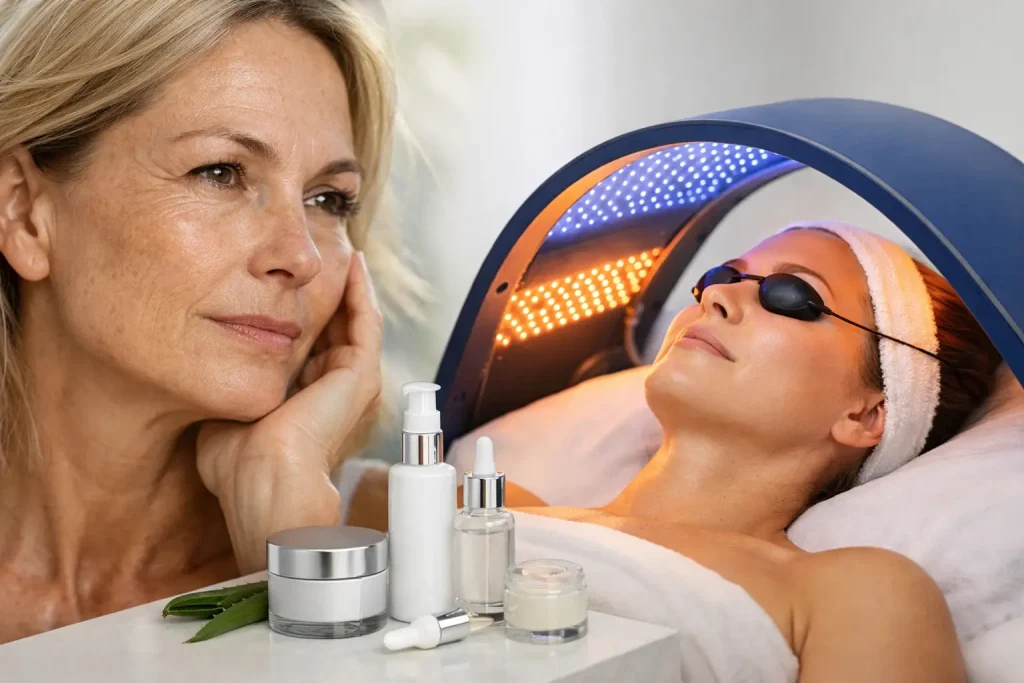
Device-led and therapist-led treatments can accelerate results when chosen carefully. Advanced facials that focus on skin health, ingredient penetration, and controlled stimulation can help improve texture and radiance. LED light therapy is particularly useful when the skin needs repair support without unnecessary heat or trauma. It can calm inflammation, support recovery, and work well alongside active homecare.
In cases where collagen loss, deeper lines, or significant photodamage are present, more progressive treatment courses may be appropriate. These should be selected based on skin condition rather than trend. The right treatment is the one that your skin can respond to safely and consistently.
Why combination plans work better than one-off treatments
Photoageing develops in layers, so repair usually works best in layers too. Homecare handles daily correction and prevention. Clinic treatments enhance penetration, stimulate repair, and keep progress moving. Review appointments allow the plan to be adjusted as the skin becomes stronger and more responsive.
This staged approach is often what separates real improvement from short-lived improvement. Skin that has been chronically exposed to UV needs rebuilding, not just polishing.
What results are realistic?
This is where honesty matters. You can absolutely improve the visible signs of photoageing, often very significantly, but skin repair is not the same as erasing history. Pigmentation can fade, tone can become clearer, texture smoother, and fine lines softer. The skin can look fresher, firmer, and healthier. But the degree of improvement depends on how advanced the damage is, how faithfully the plan is followed, and whether daily sun protection becomes non-negotiable.
Most clients benefit from thinking in phases. The first phase is stabilisation – calming inflammation, restoring barrier function, and introducing the right actives. The second is correction – targeting pigment, roughness, and collagen decline. The third is maintenance – protecting results so the skin does not slide back into the same cycle.
That maintenance phase is where long-term success is won. Even excellent treatment results can be undermined by inconsistent homecare or continued UV exposure.
Common mistakes that slow progress
One of the biggest mistakes is treating photoageing as a purely surface problem. Exfoliating more aggressively or switching products too often can leave the skin more inflamed and less able to repair. Another is expecting one treatment to handle everything at once.
There is also the issue of impatience. Clients understandably want visible change quickly, but skin remodelling follows biology, not wishful thinking. Collagen support takes time. Pigment suppression takes time. Building tolerance to active ingredients takes time. Progress is usually steady rather than dramatic overnight.
This is why a consultation-first clinic model works so well for photodamaged skin. It replaces guesswork with a treatment sequence, a homecare prescription, and realistic review points. At GRB Skin Clinic, that process is designed to improve skin function as well as appearance, which is exactly what photodamaged skin needs.
Photoageing signs and skin repair options for different ages
In your thirties, the focus is often early prevention and correction – patchy pigmentation, first fine lines, and maintaining collagen before deeper loss sets in. In your forties and fifties, the plan may need to work harder on firmness, uneven tone, and cumulative texture changes. Later on, skin can become thinner and more delicate, so treatment often needs to be active but carefully paced.
Age matters, but skin condition matters more. Someone younger with a history of intense sun exposure may show more advanced photoageing than someone older who has protected their skin consistently. That is why treatment should never be based on age alone.
The most useful next step is not another temporary cover-up. It is understanding what your skin is showing you, why it is happening, and what a structured repair plan could realistically change. When photodamage is approached early and intelligently, the skin often has far more capacity for renewal than people expect.