
Share This Post
When your skin is reactive, even the idea of treating acne scars can feel like a risk. Many people looking for acne scar treatment options for sensitive skin are not just asking what works – they are asking what works without triggering more redness, inflammation, dryness or post-inflammatory pigmentation. That is a different question, and it deserves a more careful answer.
Sensitive skin changes the treatment plan, but it does not rule progress out. The key is to treat scarring in a way that respects the skin barrier, controls inflammation and builds resilience over time. In a specialist clinic setting, that usually means fewer quick fixes, more structure, and a treatment pathway that blends professional procedures with a prescriptive home routine.
Why sensitive skin needs a different scar strategy
Acne scarring is already complex. Some scars are shallow and discoloured, some are tethered and pitted, and some are more textural than obvious in certain light. Sensitive skin adds another layer because it is more likely to overreact to friction, heat, aggressive exfoliation and high-strength actives introduced too quickly.
This matters because an irritated skin barrier does not heal efficiently. If the skin is persistently inflamed, scar treatments can become harder to tolerate and outcomes can be less predictable. In practical terms, the best approach is often not the strongest treatment available. It is the treatment your skin can tolerate consistently, with enough support around it to encourage repair.
A thorough consultation should always come first. Before discussing devices, peels or active ingredients, a skin professional needs to assess whether the skin is currently calm enough for corrective work. If you still have active acne, frequent flushing, eczema tendencies or ongoing barrier impairment, that usually needs addressing first.
Acne scar treatment options for sensitive skin in clinic
For sensitive skin, professional treatments work best when they are introduced progressively. That means choosing methods that stimulate renewal without overwhelming the skin.
LED light therapy
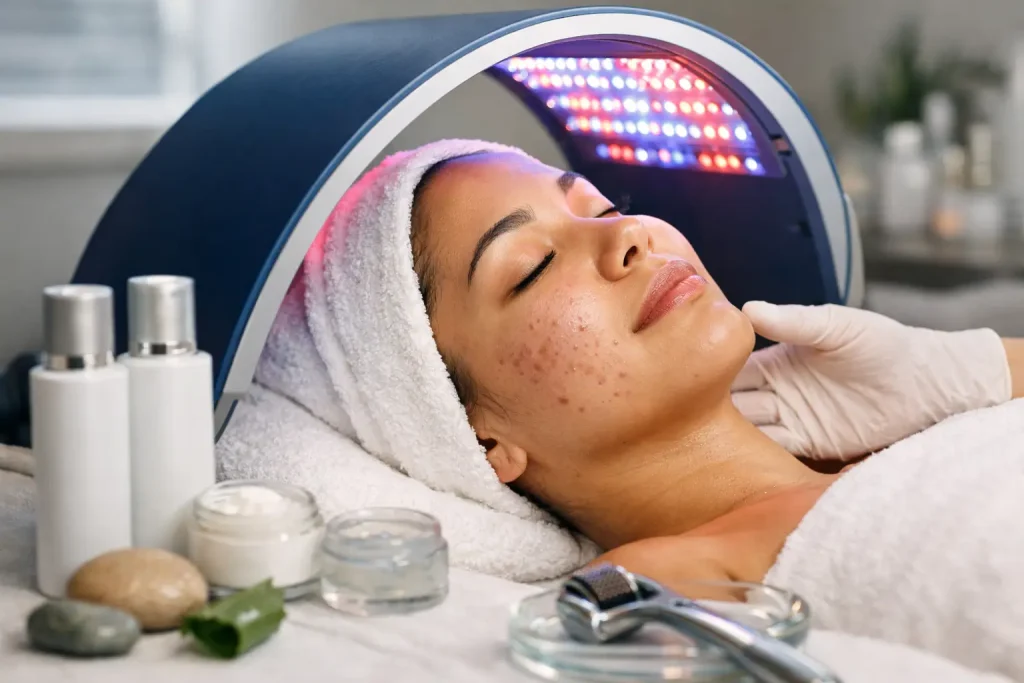
LED is often one of the most comfortable starting points for reactive skin. It is non-invasive, there is no abrasion involved, and it can help reduce visible inflammation while supporting the skin’s natural repair processes. On its own, LED will not erase deeper pitted scars, but it can be a valuable part of a broader programme.
Its real strength is that it helps create a calmer environment for healing. For clients with both lingering breakouts and early textural scarring, it can be one of the safest ways to begin treatment while improving overall skin tolerance.
Professional skin peels – chosen carefully
Not all peels are suitable for sensitive skin, and not all acne scarring responds to the same acids. The idea that stronger automatically means better is where many people come unstuck.
A well-chosen professional peel can improve post-acne marks, refine rough texture and support cell turnover. But for sensitive skin, the formulation, contact time and treatment frequency all matter. Lower-intensity, repeated peels often produce better outcomes than a single aggressive session. This is especially true if your skin is prone to stinging, visible redness or pigmentation after even minor irritation.
Peels tend to be more helpful for superficial textural change and post-inflammatory discolouration than for deeper atrophic scars. That distinction matters. They can be excellent in the right case, but they are rarely the whole answer for more established indented scarring.
Microneedling – only when the skin is ready
Microneedling can be effective for acne scarring because it stimulates collagen production and gradual skin remodelling. For the right skin, it improves texture, softens the look of shallow scars and supports stronger, healthier tissue over a course of sessions.
For sensitive skin, timing is everything. If the barrier is fragile, if acne is still inflamed, or if the skin is easily triggered, microneedling can be too much too soon. That does not always mean it is unsuitable. It may simply mean the skin needs preparation first with calming, vitamin-based support and a period of stability before needling begins.
When introduced properly, microneedling is often one of the more useful acne scar treatment options for sensitive skin, particularly for clients who want genuine structural improvement without jumping straight to more intensive resurfacing.
Bespoke facials with active ingredients
A results-driven facial in a clinical setting is not about pampering for the sake of it. Done properly, it is part of a treatment system. For sensitive, acne-affected skin, bespoke facials can support barrier function, improve hydration, help regulate congestion and allow the skin to tolerate corrective ingredients more successfully.
This matters because scar revision is not only about what happens during a procedure. It is also about what happens between appointments. If your skin remains chronically dehydrated, inflamed or overstripped, progress is slower and setbacks are more common.
When more advanced procedures may be discussed
Some acne scars do require more intensive intervention, particularly if they are deep, narrow or tethered. However, highly reactive skin is not usually the place to begin with the most aggressive option on the menu. A responsible practitioner will tell you that some treatments may need to wait until the skin is stronger, more balanced and less likely to flare.
That can be frustrating, but it is clinically sensible. Sensitive skin responds best to progressive correction, not punishment.
The role of skincare between appointments
For most clients, the home routine determines how well in-clinic work performs. If you are treating acne scars and sensitive skin together, your products need to do two jobs at once – encourage repair while protecting the barrier.
Vitamin A is often central to long-term skin improvement, but it should be introduced in a controlled, professional way. The same applies to exfoliating ingredients and pigment-regulating actives. The goal is not to throw everything at the skin. The goal is to build tolerance, improve skin function and support consistent renewal.
A prescriptive routine usually includes barrier-supportive cleansing, targeted vitamins, controlled active ingredients and daily protection from UV exposure. This is especially important because sensitive skin can mark more easily, and unprotected exposure can make post-acne discolouration linger for much longer.
If your current routine leaves your skin tight, shiny, flaky or stinging, that is not a sign the products are working harder. It is often a sign the skin is under strain.
What these treatments can realistically improve
Sensitive skin clients are often sold two extremes – either miracle claims or total defeatism. Neither is helpful. The truth sits in the middle.
Post-acne redness and brown marks often improve well with the right combination of professional treatment and homecare. Mild textural irregularity can also respond very well. Shallow rolling scars may soften noticeably over time with collagen-stimulating treatments.
Deeper ice-pick or boxcar scars are more stubborn. They can often be improved, but not usually removed completely. That is why treatment planning matters. A clinic should explain what type of scar you have, what degree of improvement is realistic, and how many sessions may be needed.
Good treatment is not just about visible change. It is also about keeping the skin calm enough to stay on track. There is little value in chasing results with a protocol your skin cannot tolerate.
How to know if your skin is ready
If your acne is still active, your skin regularly burns or flushes, or you react to most products, the first stage may not be scar treatment at all. It may be stabilisation.
That stage is not wasted time. It is often what makes later correction possible. Building skin health first can reduce the risk of rebound sensitivity, improve treatment tolerance and produce more even results.
At GRB Skin Clinic, this is exactly why consultation-led care matters. A structured plan allows the skin to move from inflamed and unpredictable to stronger, more resilient and ready for correction. For many clients, that shift alone is the point where skin starts to feel manageable again.
Choosing the right clinic approach
If you have sensitive skin, look for a practitioner who talks about preparation, barrier function and progression – not just devices. The most effective acne scar treatment options for sensitive skin are rarely chosen in isolation. They are selected as part of a wider treatment programme based on skin behaviour, scar type, pigmentation risk and your ability to tolerate active ingredients.
That kind of planning is especially valuable if you have spent years trying to self-manage reactive breakouts and leftover marks with products that promised speed. Sensitive skin usually does better with expert restraint.
There is no single best treatment for everyone. There is, however, a best sequence. When your skin is assessed properly, strengthened first and treated with consistency, meaningful scar improvement becomes far more achievable.
If your skin has been telling you that harsh methods are not the answer, it is worth listening. Sensitive skin does not need tougher treatment. It needs smarter treatment, delivered at the right pace.