
Share This Post
If you have ever wondered why one client sees a dramatic reduction in hair after a few sessions while another needs a longer course, the answer usually comes back to the technology, the treatment plan, and the skill of the practitioner using it.
Laser hair removal is not a one-size-fits-all beauty treatment. It is a clinically led process that targets the hair follicle with controlled light energy while protecting the surrounding skin. When it is done properly, it offers long-term reduction, smoother skin, and freedom from the cycle of shaving, waxing, ingrown hairs and irritation. But the phrase itself can make the treatment sound simpler than it is.
What laser hair removal technology actually does
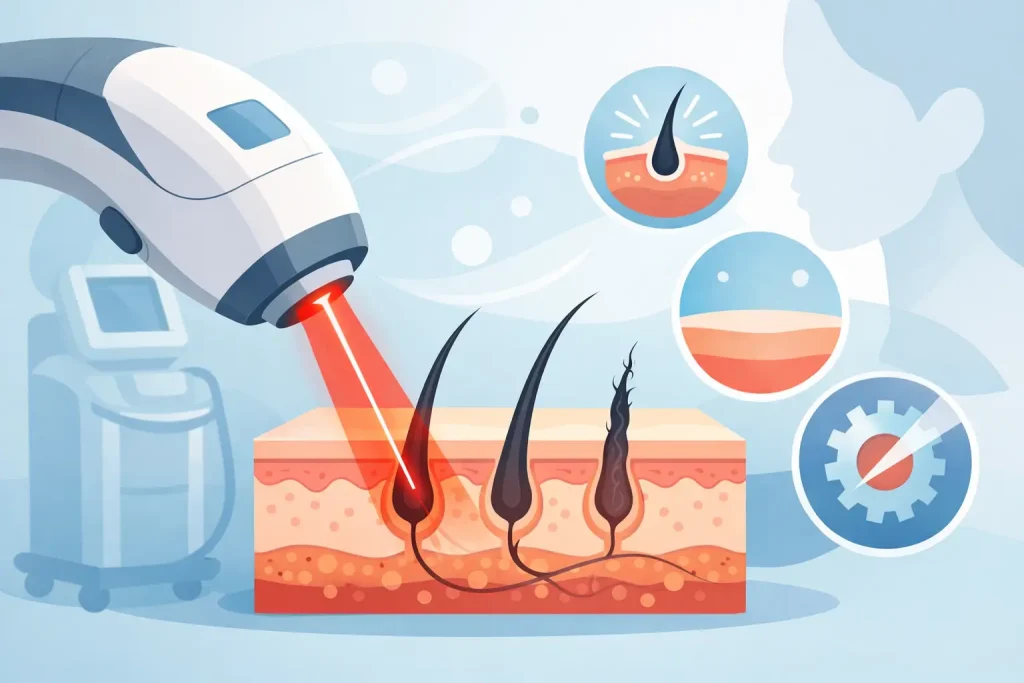
At its core, laser hair removal technology uses a specific wavelength of light that is absorbed by melanin in the hair. That light converts to heat, and the heat damages the follicle enough to reduce its ability to regrow hair.
The key word here is reduce. Hair grows in cycles, and only hairs in the active growth phase are effectively treated at the time of the appointment. That is why a course of sessions is needed rather than a single treatment. It is also why honest expectation-setting matters. The goal is significant long-term reduction, not a casual promise of instant permanence.
This is where a consultation-first approach becomes essential. Hair colour, skin tone, hormonal influences, treatment area and medical history all affect how the skin responds and how many sessions are likely to be required.
Why different laser hair removal technology gives different results
Not all systems work in the same way, and not all devices are suitable for every skin type. This is one of the main reasons results can vary so widely between clinics.
Some systems are better suited to lighter skin with dark coarse hair, where there is a strong contrast between the pigment in the hair and the pigment in the skin. Others are designed to work more safely across deeper skin tones by using wavelengths that bypass more surface melanin and target the follicle at a greater depth.
In practical terms, the best technology is the one that matches the individual in front of the practitioner. There is no single machine that is automatically best for everyone. A clinic that treats laser hair removal as a structured treatment plan, rather than a quick add-on service, will assess this properly before starting.
The role of wavelength
Different laser systems operate at different wavelengths, and wavelength affects how deeply the energy travels and what it targets most effectively.
Shorter wavelengths can be very effective for pale skin and dark hair, but they may carry more risk in darker skin tones if used incorrectly. Longer wavelengths tend to penetrate more deeply and are often preferred for safer treatment on a broader range of skin types. The settings also matter just as much as the machine itself. Energy level, pulse duration and cooling all need to be adjusted with care.
Why cooling matters
Good laser hair removal technology is not only about delivering heat. It is also about protecting the skin. Cooling systems help keep the epidermis comfortable and reduce the risk of unnecessary surface heat.
That means treatment can be more tolerable and more controlled. It also supports consistency, which matters when you are committing to a course of sessions and expecting measurable progress over time.
Who gets the best response to treatment
The classic ideal candidate has fair skin and dark hair because the laser can easily distinguish the pigment in the hair from the surrounding skin. However, modern systems have widened the range of who can be treated safely.
Even so, there are limits. Very blonde, red, grey or white hairs often do not respond as well because there is not enough pigment for the laser to target. Fine facial hair can also be more unpredictable than coarse underarm, bikini or leg hair.
Hormones play a part too. Areas influenced by hormonal activity, particularly the face, chin and neck, may require more maintenance. Conditions such as PCOS can increase the likelihood of ongoing stimulation of new growth. This does not mean treatment is unsuitable. It means planning needs to be realistic and tailored.
What to expect from a proper treatment course
A professional laser course is built around the biology of hair growth, not convenience alone. Sessions are spaced to catch new hairs entering the active growth phase. Depending on the area, this may mean appointments every four to eight weeks, sometimes longer.
Most clients need a series of treatments before they see the full benefit. Early on, you may notice slower regrowth, softer texture and patches where the hair becomes visibly thinner. Over time, that typically progresses to a clear reduction in density.
This is also why bargain messaging can be misleading. If a clinic sells laser as though one or two sessions will solve everything, that is usually a red flag. Effective treatment requires consistency, review and adjustment.
Safety is not a footnote
Laser is a results-driven treatment, but safety is what makes those results worth having. The skin must be assessed properly before treatment begins. Recent sun exposure, fake tan, certain medications, active skin irritation and some health conditions can affect whether treatment should go ahead that day.
Patch testing is also an important part of the process. It helps assess how the skin responds and guides safe parameter selection. This is especially important when treating more reactive skins, deeper skin tones, or clients with a history of pigmentation concerns.
Protective eyewear, strict hygiene standards and detailed aftercare are all part of a clinical standard of treatment. These are not optional extras. They are part of responsible practice.
Why practitioner expertise matters as much as the machine
A sophisticated device in untrained hands is not a guarantee of good outcomes. Laser hair removal technology only performs as well as the person assessing the skin, selecting the settings and monitoring the response.
An experienced practitioner looks beyond the machine. They consider your skin health, hair pattern, treatment history and long-term goals. They also know when to adjust the plan, when to delay treatment, and when to explain that some hairs or some areas may respond more slowly.
This is where specialist clinics stand apart from general beauty settings. A therapist-led, clinically informed approach gives clients clearer guidance and a safer, more strategic treatment journey.
Preparing the skin for better results
Preparation affects outcome more than many people realise. The area usually needs to be shaved before treatment so the energy can travel efficiently to the follicle rather than being wasted on surface hair. Waxing, plucking and threading should be avoided before a course because they remove the target the laser needs to see.
Sun exposure also matters. Tanned skin increases risk because there is more melanin in the skin competing with the hair for the laser energy. That is why timing, SPF use and honest pre-treatment guidance are so important.
Healthy skin tends to cope better as well. If the skin barrier is inflamed, compromised or highly sensitised, treatment may need to be postponed until the area is calmer.
Laser hair removal technology and realistic expectations
One of the most empowering things a clinic can do is tell the truth clearly. Laser can produce excellent long-term reduction, but it does not switch off every follicle forever, for every person, in every area.
Some clients will need occasional maintenance, especially on hormonally influenced areas. Some will achieve a very dramatic reduction and only need the odd review session later. It depends on the individual biology, the area being treated, and how consistently the plan is followed.
The good news is that even where maintenance is needed, the hair is often finer, sparser and easier to manage. For many clients, that is the real transformation. Less irritation. Fewer ingrown hairs. Less daily effort. More confidence in the skin.
At GRB Skin Clinic, that kind of progress is always approached as part of a personalised treatment plan rather than a rushed cosmetic fix. If you are considering laser, the smartest first step is not choosing the cheapest offer. It is choosing a practitioner who will assess your skin properly, explain the technology honestly, and guide you through a course that is built around safe, measurable results.
The right treatment should leave you feeling informed, not sold to – and that is usually where the best outcomes begin.