
Share This Post
That tight, shiny feeling after cleansing. Makeup that suddenly looks patchy by lunchtime. A “mystery breakout” that arrives alongside stinging, redness and flaking. In clinic, these patterns rarely mean your skin is “being difficult”. They usually mean your skin barrier is asking for a reset.
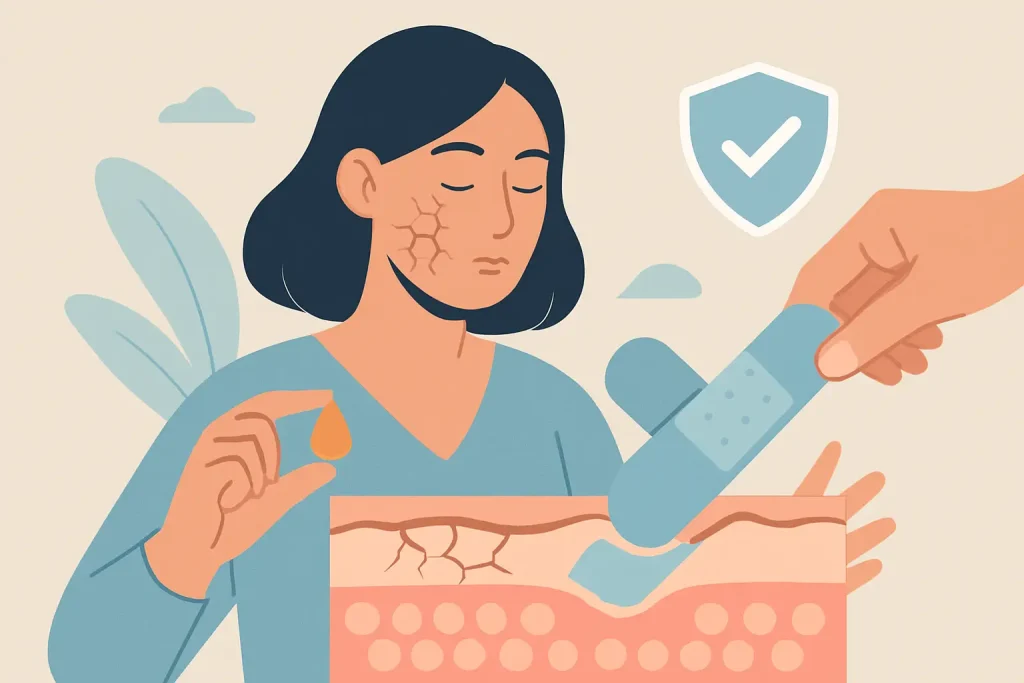
Your barrier is not a vague skincare buzzword. It is the outermost architecture of the skin (the stratum corneum) working like a brick wall: skin cells are the bricks, and lipids (ceramides, cholesterol and fatty acids) are the mortar. When that mortar is depleted or the bricks are disrupted, water escapes (transepidermal water loss increases), irritants enter more easily, and inflammation becomes your skin’s default setting. This is why a barrier issue can mimic acne, sensitivity, eczema-like flares and even pigmentation problems.
Below is a clinician-style, expectation-setting guide on how to repair damaged skin barrier – not as a quick fix, but as a structured return to calm, resilient function.
How to know your skin barrier is damaged
A barrier problem is often less about one dramatic symptom and more about a cluster of small changes that arrive together. Stinging when applying products (including ones you’ve used for months) is a common clue. So is persistent tightness after washing, or a surface that looks dehydrated yet feels oily.
If you are noticing redness that lingers, sudden flaking around the mouth or nose, or sensitivity to temperature changes (wind, central heating, hot showers), your skin is behaving like it is under-protected. Acne clients often report that spots become more inflamed and slower to heal, while pigmentation-prone skin can look more reactive after sun exposure or active ingredients.
There is nuance here. Rosacea, eczema, perioral dermatitis and allergic contact reactions can look similar, and they require different decision-making. If you are unsure, do not keep “testing” products on yourself. That usually prolongs the inflammation cycle.
Why barriers break (and why it matters)
Barrier damage is commonly created by over-cleansing, over-exfoliation and high-frequency use of strong actives. The modern routine can quietly become aggressive: a foaming cleanser twice daily, a cleansing brush, an acid toner, retinoids, spot treatments, plus a clay mask “because I’m oily”. Add in stress, poor sleep, seasonal changes, and you have a perfect storm.
Treatments can contribute too. Chemical peels, microneedling, laser and even LED protocols have an appropriate place, but only when the skin is adequately prepared and supported afterwards. The goal is intelligent stimulation, not repeated irritation.
Why it matters: when the barrier is compromised, almost every skin goal becomes harder. Acne becomes more inflamed, pigmentation becomes more persistent, and anti-ageing actives become less tolerable. Repairing the barrier is not a detour from results. For most people, it is the fastest route back to progress.
Step 1: Pause the “push” products (for now)
If your skin is actively stinging, peeling, burning, or reacting daily, you need a short, disciplined reduction phase. This is where many motivated clients struggle, because it feels like doing less should give you less.
For 7-14 days, remove exfoliating acids (glycolic, lactic, salicylic if it is stinging), scrubs, cleansing brushes, strong benzoyl peroxide, fragranced products and high-strength retinoids. If you are using multiple actives, keep only the ones that are non-negotiable and well tolerated. If you are on prescription acne treatment, do not stop without clinical advice – instead, adjust supporting skincare around it.
You are not abandoning results. You are creating the conditions for your skin to respond predictably again.
Step 2: Cleanse like you are protecting a wound
Cleansing is where most barrier repair succeeds or fails.
Choose a low-foam, non-stripping cleanser that rinses clean without leaving the skin tight. Avoid very hot water. Keep contact time short. If you wear makeup or SPF, a gentle first cleanse is fine, but do not over-massage the skin for minutes. Mechanical friction is underestimated as an inflammation trigger.
In the morning, many barrier-compromised clients do better with a water rinse or a very light cleanse, then moisturiser and SPF. At night, cleanse properly, but gently.
Step 3: Rebuild the lipid “mortar” with a simple moisturising strategy
Barrier repair is less about chasing a single hero product and more about combining three functions: hydration, lipid replacement and water-loss prevention.
Hydration means humectants that attract water into the upper layers of the skin. Lipid replacement means adding back ceramides, cholesterol and fatty acids, or barrier-supportive oils that mimic the skin’s own profile. Water-loss prevention means occlusives that slow evaporation, especially overnight.
The trade-off is texture. The richer the product, the more likely it is to feel heavy on very congestion-prone skin. That does not mean you cannot repair your barrier if you break out easily. It means your product selection needs to be precise, and sometimes you use richer textures only in targeted zones (around the mouth, cheeks) while keeping the T-zone lighter.
Apply moisturiser to slightly damp skin and do not wait until you are “dry” and tight. Think of moisturising as sealing in calm.
Step 4: SPF is non-negotiable (even when you are “just repairing”)
UV exposure is a barrier stressor and an inflammation driver. It also worsens post-inflammatory hyperpigmentation, which is why acne clients often feel stuck in a cycle of marks.
Use a broad-spectrum SPF every day, even in Greater Manchester cloud cover. If your skin is reactive, opt for gentle formulas that do not sting. Mineral SPF is often better tolerated when the barrier is fragile, but it depends on the base and your skin type. The right SPF is the one you can wear consistently without irritation.
If you are repairing a barrier and still chasing a tan, your skin is receiving mixed signals. Healing requires protection.
Step 5: Bring back actives in a planned, not emotional, way
Once stinging has stopped and your skin feels comfortable through the day (often 2-4 weeks, sometimes longer), you can reintroduce actives with a structured schedule.
Retinoids are excellent for acne, texture and photodamage, but they need respect. Start low and slow. Two nights a week is a sensible re-entry point for many, then increase only if the skin remains calm.
Exfoliation is similar. More is not better. If your goal is clear pores, consider whether the issue is congestion, inflammation, or both. Over-exfoliation can create more oiliness as the skin attempts to defend itself.
If pigmentation is your concern, avoid stacking multiple brightening acids and peels at home while the barrier is recovering. Pigment management is a long game that rewards consistency and low irritation.
Step 6: Support the repair process with clinic-led judgement
Barrier repair is a perfect example of why professional skin analysis matters. Two people can present with “dry, spotty, red” skin and require completely different protocols.
In a consultation, we look at your triggers (actives, cleansing habits, treatments), your timing (what changed, when), and your goals (acne control, pigmentation, anti-ageing). From there, we can choose the right level of intervention. Sometimes the best step is to stabilise your homecare first. Other times, targeted LED light therapy can help settle inflammation while you rebuild tolerance. If you are in a cycle of frequent breakouts and irritation, a therapist-led acne programme often achieves more than product-hopping.
If you want that structured approach, GRB Skin Clinic offers consultation-led treatment planning and prescriptive routines designed to restore function first, then progress outcomes. You can start at https://www.grbbeauty.com.
How long does it take to repair a damaged skin barrier?
Expect meaningful comfort improvements within 7-14 days if you remove irritants and moisturise intelligently. Deeper resilience often takes 4-8 weeks because the skin needs time to normalise its renewal cycle and lipid production.
If you have underlying dermatitis, chronic stress, are using prescription treatments, or have been over-exfoliating for months, it can take longer. The most common reason people fail to repair the barrier is reintroducing actives too quickly because the skin “looks better”, then triggering the same inflammation again.
Common mistakes that keep the barrier stuck
The first is cleansing too harshly because the skin is breaking out. Inflammation-driven acne does not respond well to stripping routines.
The second is rotating too many new products at once. Your skin cannot tell you what is helping if you change everything every three days. Keep the routine quiet.
The third is treating flaking with more exfoliation. Flaking from barrier damage is not the same as “dead skin build-up”. Often it is a sign of inflammation and dehydration.
The fourth is ignoring environmental factors. Central heating, long hot showers, intense gym sessions followed by not cleansing gently, and inconsistent SPF all add friction to the healing process.
Your skin barrier is designed to recover. Give it fewer battles, and it will usually meet you halfway.
If you are currently in the uncomfortable phase – stinging, tightness, unpredictable breakouts – take it as useful information, not failure. The most powerful skincare move is often the most disciplined one: simplify, protect, rebuild, then reintroduce progress step by step. That is how you earn long-term skin confidence, not just a good week.