
Share This Post
Acne can settle while its evidence remains: indented texture, uneven tone and marks that make skin feel difficult to manage without coverage. When comparing microneedling vs chemical peel for acne scars, the right answer is rarely a one-treatment decision. It depends on the type of scarring present, whether acne is still active, your skin’s resilience and how consistently you can follow a professionally prescribed home programme.
At GRB Skin Clinic, we assess the skin before recommending a course. Acne scarring is not a single concern, and treating it as one can lead to disappointing progress. A structured plan gives the skin time to respond, repair and build towards more even texture safely.
Why acne scar type changes the treatment choice
The word “scar” is often used for several different concerns. Post-inflammatory marks may appear red, brown or greyish after a spot has healed, but they are not necessarily true scars. They can improve as inflammation is reduced, the skin barrier is supported and cell turnover is carefully managed.
True acne scars involve a change in the skin’s structure. Rolling scars create broad, wave-like unevenness. Boxcar scars have more defined edges and depressions. Ice-pick scars are narrow and deeper. Some people also develop raised scars, which require a different clinical approach altogether.
Microneedling and chemical peels can both have a place in scar management, but they work in different ways. Neither should be viewed as a quick-fix facial. Meaningful improvement is progressive, and the aim is healthier, stronger skin with a smoother-looking surface over time.
Microneedling vs chemical peel for acne scars: the key difference
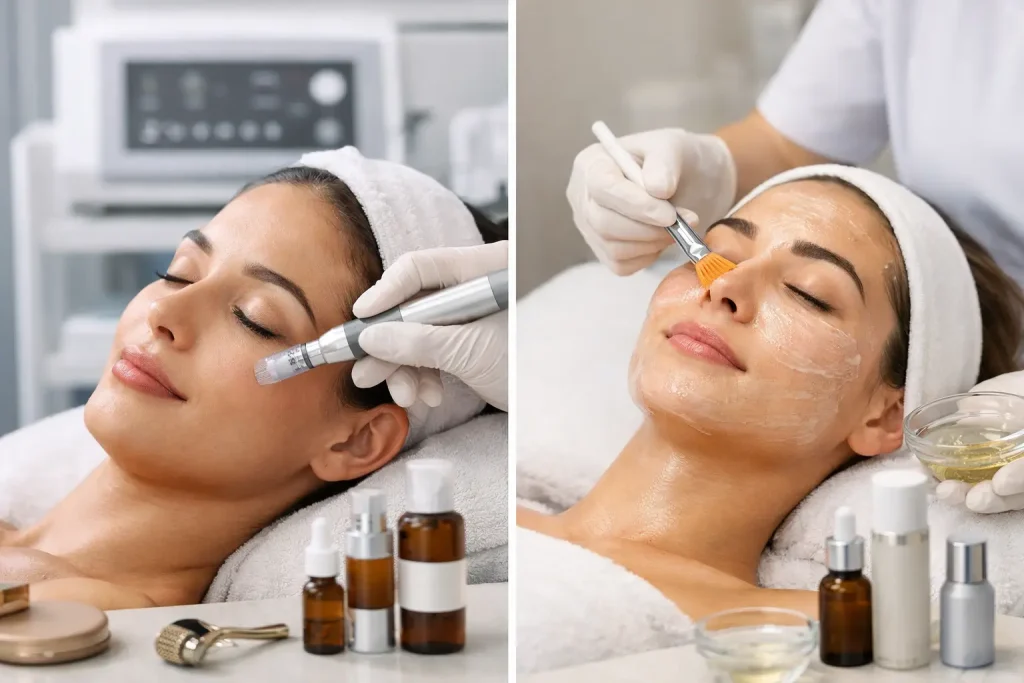
Microneedling is a collagen-induction treatment. A professional device creates controlled micro-channels in the skin, prompting a wound-healing response. In the weeks that follow, the skin begins remodelling its collagen and elastin network. This makes microneedling particularly relevant for indented acne scars and uneven texture.
A chemical peel uses a selected acid formulation to encourage controlled exfoliation and renewal. The depth and strength of the peel are chosen according to the skin’s condition, sensitivity, current acne activity and treatment goals. Peels are often valuable for congestion, dullness, surface roughness and lingering post-acne marks.
Put simply, microneedling is generally chosen when the priority is rebuilding texture from within. Chemical peels are often chosen when the priority is improving surface behaviour, clarity and uneven tone. Many clients benefit from a planned combination, rather than being limited to one approach throughout their journey.
When microneedling may be the better option
Microneedling is often considered when acne is under control and the main concern is shallow-to-moderate depressed scarring. It can support a gradual improvement in skin density, texture and the softened appearance of rolling or boxcar scars.
It is not normally the first step for inflamed, active breakouts. Needling through active inflammation can be counterproductive, so the first phase may focus on settling acne, reducing congestion and strengthening the skin before scar-focused work begins.
Most people need a course rather than a single session. The skin needs recovery time between appointments to complete its repair process, and collagen remodelling continues well after visible redness has faded. Results are therefore measured over months, not days.
Following treatment, skin may look flushed and feel warm or tight for a short period. There can be temporary dryness or light flaking as the barrier settles. A therapist-led aftercare plan is essential, particularly for clients prone to post-inflammatory pigmentation.
When a chemical peel may be the better option
A chemical peel can be an excellent first choice for skin that is still prone to congestion, frequent breakouts, uneven tone or persistent post-acne marks. By improving the way dead skin cells shed and supporting more refined surface renewal, the correct peel programme can help the complexion look clearer and more even.
Peels vary greatly. A light peel may involve minimal visible shedding and suit a client who needs little downtime. A more active clinical peel may create several days of dryness, tightness or peeling. The goal is not to create the most dramatic flake possible. The goal is to select an appropriate level of stimulation for your skin, at that stage of its treatment plan.
For deeper indented scars, a peel alone is unlikely to deliver the same textural change as a carefully planned microneedling course. However, it may still be highly useful in preparing the skin, improving active acne and maintaining clarity between other treatments.
The trade-off: recovery, commitment and expectations
Both treatments ask for commitment, but in different ways. Microneedling usually involves more visible immediate redness, followed by a period of repair. Chemical peels can involve less redness but more noticeable dryness or peeling, depending on the formulation used.
Microneedling is not a one-off solution for established acne scars. It relies on repeated, controlled stimulation and a consistent professional skincare routine that supports recovery. Chemical peels also work best as a programme, especially where ongoing congestion and pigmentation are part of the picture.
Your diary matters too. If you have a major event, holiday or work commitment approaching, treatment timing should be discussed in advance. Skin cannot be rushed into healing simply because a date is in the calendar.
There is also the matter of skin tone and pigmentation risk. Darker skin tones and anyone with a history of marks lingering after blemishes need a particularly considered approach. Treatment intensity, preparation, aftercare and product selection all affect how safely the skin progresses.
Why a consultation should come before either treatment
The most effective acne scar plans do not begin with a device or a peel. They begin with analysis. A trained therapist needs to identify whether you are dealing with active acne, marks, true scarring, sensitivity, dehydration, impaired barrier function or a combination of concerns.
Your current skincare, health history, previous treatments and lifestyle factors also influence the plan. For example, skin that is irritated or sensitised may need a period of barrier support before it is ready for progressive corrective work. Trying to treat scars on compromised skin is rarely productive.
At consultation, the discussion should be honest about what each treatment can and cannot achieve. Deep ice-pick scars, raised scarring and severe textural changes may need a more specialist or combined clinical pathway. A responsible recommendation is tailored to the skin in front of us, not based on the latest trend.
A stronger route to long-term improvement
For many clients, the best route is phased. The early phase focuses on controlling active acne and improving the skin’s overall health. Once breakouts are more stable, a programme may introduce chemical peels for clarity and surface renewal, then microneedling for targeted texture work where suitable.
Professional product prescriptions matter throughout. High-performance active ingredients need to be introduced at the right pace, not layered into an already reactive routine. The right homecare supports treatment outcomes between appointments, helps maintain skin comfort and gives you a practical role in your own progress.
Photography and regular reviews are useful because scar improvement can be subtle from week to week. Comparing skin over several months gives a more accurate picture of changes in texture, clarity and confidence. It also allows the plan to be adjusted as the skin responds.
Which treatment should you choose?
Choose neither until you know what you are treating. If your main concern is active acne, congestion and post-acne marks, chemical peels may be the more appropriate starting point. If acne has settled and indented texture is the concern, microneedling may offer greater potential for collagen-led improvement. If both are present, a staged combination is often the most intelligent option.
The most helpful next step is a detailed consultation with a skin specialist who can assess your scarring, current acne activity and skin health in person. With the right sequence, realistic timelines and consistent homecare, acne-scar treatment becomes less about chasing a flawless finish and more about restoring skin that feels stronger, clearer and more like your own.