
Share This Post
You can usually spot photodamage before anyone says the word. It is the patchy brown marks that do not quite fade with “brightening” products. The fine lines that appear first on the cheekbones and around the eyes, even if you are otherwise well hydrated. The rough, slightly sandpapery texture on the forehead that foundation clings to, no matter how carefully you prep.
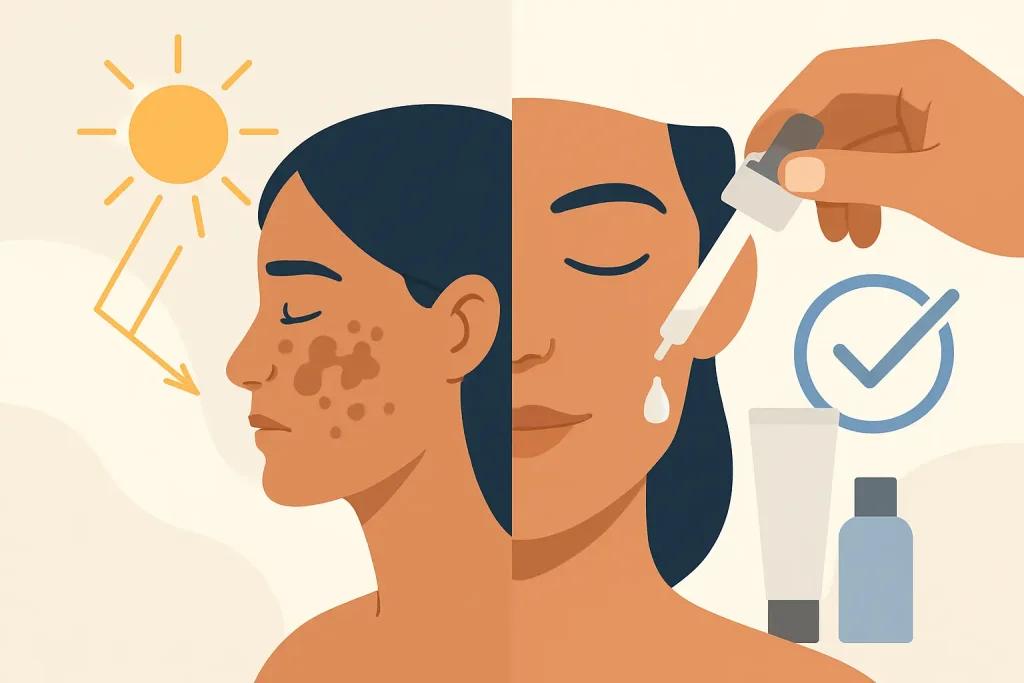
Photodamage is not just “a bit of sun”. It is cumulative biological change. And the reason a proper photodamage skin treatment plan works is because it targets what UV exposure disrupts: pigment control, collagen integrity, barrier function, and chronic inflammation.
What photodamage really is (and why it keeps showing up)
Photodamage is the result of repeated ultraviolet exposure – UVB triggers visible burning and direct DNA injury, while UVA penetrates deeper and quietly degrades collagen and elastin. Over time, the skin becomes less efficient at repairing itself. Pigment cells become reactive and uneven, blood vessels become more noticeable, and the surface layer thickens in patches as the skin tries to protect itself.
That is why photodamage often looks like a mix of concerns rather than one problem. You might see pigmentation and fine lines together, enlarged pores with rough texture, or a combination of dullness, redness and persistent dehydration.
There is also an honest “it depends” here. Some people tan and stay fairly even-toned but develop more laxity and crepiness. Others are prone to freckling, melasma or post-inflammatory pigmentation and notice blotchiness long before they notice lines. Your genes, hormones, heat exposure, and how well your barrier holds up all influence your pattern of photodamage.
Signs your skin is asking for a different approach
If you are trying to treat photodamage at home and not getting traction, it is usually because your strategy is too gentle, too inconsistent, or missing one of the core levers.
Look for these patterns: pigmentation that returns quickly after summer; fine lines that are sharper when your skin is dry; texture that feels thick or bumpy even when you exfoliate; redness that lingers; makeup that sits unevenly because the surface is no longer smooth.
Also, if you have a history of breakouts, be careful with the assumption that photodamage is only “anti-ageing”. UV thickens the outer layer and can trap oil more easily, which means photodamage and congestion can travel together.
Photodamage skin treatment: what genuinely changes the skin
A results-driven plan usually combines three elements: protection so the damage stops accumulating, correction to signal healthier behaviour in the skin, and stimulation to rebuild what UV has broken down.
1) Daily protection that is non-negotiable
No corrective plan can outpace daily UV exposure. That does not mean living indoors. It means treating sunscreen as part of your treatment, not an optional add-on.
Choose a broad-spectrum SPF 15-20 you will wear every day, even in Greater Manchester cloud cover. Reapply if you are outside for more than a couple of hours, driving long distances, sitting by windows, or taking the dog out repeatedly. If you are dealing with pigmentation, this one step often makes the difference between “it helped a bit” and “it finally stayed calm”.
2) Vitamin A in a structured, skin-intelligent way
Vitamin A is central to many professional photodamage protocols because it normalises cell turnover, supports collagen-building pathways, and improves pigment dispersion over time. The catch is dosing and timing. Jumping straight to a strong retinoid when your barrier is compromised often creates redness, sensitivity and a stop-start routine that never becomes consistent.
A clinician-led approach normally builds you up gradually so your skin adapts. Expect a settling-in phase. Mild dryness or flaking can be normal, but persistent stinging, tightness or dermatitis is not a badge of progress – it is a signal to adjust.
3) Antioxidants to reduce daily inflammatory load
UV exposure generates oxidative stress. Antioxidants help reduce the ongoing inflammatory pressure that keeps pigmentation and redness active.
Vitamin C is well known, but it is not one-size-fits-all. Some formulas sting or break out reactive skin. A prescription approach matches antioxidants to your tolerance and your goal – pigmentation control, redness reduction, or collagen support.
4) Pigment regulation without over-stripping
If your photodamage presents mainly as uneven tone, your plan needs pigment regulators alongside barrier support. Over-exfoliating can temporarily look “brighter” then rebound into more irritation and more pigment.
Well-designed pigment routines focus on steady regulation and calm, not constant peeling. This is particularly important for melasma-prone skin where heat and inflammation can drive relapse.
In-clinic treatments that move the needle
Homecare builds the foundation. Clinic treatments accelerate outcomes, but they work best when they are selected for your specific pattern of damage and your skin’s reactivity.
LED light therapy for repair signalling
LED can be a powerful support in photodamage plans because it encourages healthier cellular behaviour without the downtime of aggressive resurfacing. It is especially useful when you need to calm inflammation, support healing, and strengthen resilience while you are building tolerance to actives.
LED is not a “one and done” treatment. It is cumulative. The people who see the best results treat it like training – consistent sessions over a set period.
Bespoke active facials for texture and clarity
A therapist-led facial that uses high-potency actives can address the uneven surface layer, dehydration and congestion that often sit on top of photodamage. The key is bespoke selection and sequencing: too much exfoliation on a sensitised barrier can flare redness, while too little will not shift texture.
When done clinically, these facials also reinforce good habits – proper cleansing, barrier repair, and the correct pacing of active ingredients at home.
Pigmentation-focused protocols with progressive intensity
Photodamage and pigmentation respond well to progressive treatment courses. The word “progressive” matters. You want a plan that increases intensity as your skin strengthens and behaves more predictably, rather than hitting hard on week one and spending the next month managing irritation.
Depending on your skin type and lifestyle, this may include professional exfoliation strategies, targeted brightening protocols, and supportive LED. For some clients, device-led options may be appropriate, but the decision should be based on skin analysis, the depth of pigment, and how easily you mark.
The trade-offs: what to expect (and what to avoid)
Photodamage improvement is realistic, but it is not instant. Pigment can look worse before it looks better if the upper layers are being normalised and old pigment is surfacing. Fine lines soften as hydration improves and collagen support becomes consistent, but deeper etched lines take longer and may not disappear completely.
The most common mistake is chasing speed and ending up with inflammation. Inflammation is the fuel for uneven pigment, persistent redness and barrier breakdown. If you have ever reacted to a product and then noticed your marks looked darker afterwards, you have seen this effect in real life.
Another mistake is treating the face but forgetting the neck, chest and hands. These areas often show photodamage earlier because the skin is thinner and sunscreen habits are less consistent. A smart plan extends your routine to where you want the result to match.
Building your plan: a clinician’s way of thinking
A strong photodamage skin treatment plan usually starts with analysis, then a staged routine, then a course of treatments. The order matters.
First, identify what is dominant: pigment, texture, redness, laxity, or a combination. Then check barrier status. If your skin feels tight after cleansing, is reactive to “active” products, or flushes easily, you earn better long-term results by rebuilding tolerance before pushing correction.
Next, build the home routine so it is actually doable. This is where most people fail – not because they do not care, but because the routine is too complicated or too harsh. Consistency beats complexity.
Finally, choose clinic treatments that match your stage. Early on, calming and supportive modalities help your skin behave. Later, more corrective protocols can be layered in once your barrier is stable and your pigment response is more predictable.
If you want this handled with a structured consultation and a therapist-led plan, GRB Skin Clinic works exactly this way, with progressive protocols and prescriptive homecare support: https://www.grbbeauty.com.
How long does photodamage take to improve?
You can often feel texture changes within weeks when your routine is correct. Visible pigment changes commonly take 8-12 weeks of consistent homecare and strict daily SPF, and longer if the pigment is deeper or hormonally driven. Collagen remodelling is slower still – think months, not days.
The encouraging part is that good skin behaves better quite early. Once inflammation drops and hydration normalises, makeup sits differently, redness is calmer, and the skin looks more even in daylight. Those early wins make it easier to stay consistent while the deeper changes catch up.
If you are starting from a place of long-standing sun exposure, do not aim for perfection. Aim for momentum: clearer tone, smoother texture, stronger resilience, and fewer flare-ups. That is what “restoring youthful vitality” looks like in real life – not chasing a filter, but building skin that heals and holds onto its results.
The most helpful thought to take with you is this: your next week of UV exposure matters just as much as your last ten years. Protect the progress you are about to create, and your skin will finally have the space to change.